Your Product Backlog Has 1,847 Feature Requests and Nobody Reads Them
Your CPO opens the request queue Thursday, 1,847 open items across four tools, 12 tagged this quarter, six shipped from the list. Product feedback is a function you never staffed.

It is Thursday, August 6th, 10:24 AM. Your CPO opens the Productboard queue in a tab named Feedback Inbox (1,847). She filters by "last 30 days". 214 new items. She filters by "tagged". 12 items. She filters by "linked to a Jira epic". 4 items. She opens the top of the untagged pile. A Gong snippet from July 29th, an enterprise buyer on the $410K expansion call asking for SSO on the reporting module, no owner, no tag, no linked opportunity.
She scrolls. A Zendesk macro shows the SSO request has surfaced 34 times since March across 19 accounts totaling $2.1M ARR. Nobody clustered them. A Slack thread in #customer-wins from July 22nd shows the head of sales lost a $180K deal to a competitor whose intake form flagged the same SSO gap. A Notion doc from the design team dated June 4th proposes an SSO spec. It sits at 12 comments and zero assignees. Meanwhile the roadmap deck presented at last week's board meeting names Q4 shipping items decided in a two-hour offsite in April.
Pull the last four quarters of the feedback queue. 1,847 open items, 12 tagged this quarter, six shipped from the list, 214 new items last month against a triage capacity of 40. Cross-check every shipped roadmap item against the queue and 4 of 11 shipped items had no linked customer signal at all. The board deck shows Q3 shipping velocity. The board deck does not show that the highest-ARR feedback signal of the year sat untagged for 71 days while the team shipped a preference toggle nobody asked for.
Product feedback is a function. Most Series B and C teams have not staffed it because the first 200 customers were read by the founder over morning coffee. The count grew to 4,200 customers, an Intercom instance the CS team routes tickets through, a Gong library with 3,400 call recordings, a Zendesk queue the support lead scans on Mondays, a Productboard the CPO opens on the 1st, a #customer-feedback Slack channel with 214 messages a week, and a Notion roadmap doc rewritten every quarter offsite. The function lives in the gap between the CPO who owns the roadmap, the head of CS who owns account health, the head of sales who owns lost-deal notes, the design lead who owns discovery, and the support lead who owns the ticket queue. On the org chart it sits under product. In practice it sits inside a Productboard tab nobody opens between offsites.
The 1,847-item backlog math
Pull every feedback item logged the last twelve months across Productboard, Intercom, Gong, Zendesk, and the #customer-feedback Slack channel. Log source, date, tag state, cluster state, linked account ARR, linked opportunity value, shipped state, time to first tag. Count items with zero tag past day 14. Count clusters of five or more items with no owner. Count shipped roadmap items with no linked feedback signal. Most teams past Series B find 60 to 80 percent of items sit untagged past day 30, 30 to 50 percent of shipped roadmap items carry no linked customer signal, and one in six enterprise-account feedback items surfaces after the deal has already slipped.
Walk one signal. The SSO request first surfaced March 4th in a Gong call with a mid-market prospect who chose a competitor two weeks later. The lost-deal note in HubSpot cited "auth requirements" and got no roadmap linkage. It surfaced again April 12th, May 9th, May 22nd, and eight times in June across the CS ticket queue. The July 22nd Slack post named the specific $180K loss. The July 29th Gong snippet named the $410K expansion at risk. No single owner ran the cluster back to a $2.1M ARR signal with a shipping recommendation before the CPO opened the queue on August 6th.
The team that should own this knows it is broken. The CPO reads 30 to 40 items a week in Productboard between meetings. The CS lead flags tickets that sound urgent in the moment. The head of sales posts lost-deal notes in Slack when the deal is fresh. The design lead runs discovery on the two themes the last offsite chose. The support lead scans the queue for volume spikes on Monday mornings. No single owner reads every signal across every source every day, clusters them by theme, ties each cluster to ARR at risk and ARR available, and hands the CPO a ranked shipping brief before the roadmap meeting.
Hiring a product ops lead is the slow answer
The textbook fix is a senior product operations lead or a director of voice of customer. Loaded comp in the US runs $170K to $240K a year. Months one through three go to consolidating the feedback tools, building a taxonomy, and standing up a weekly triage ritual. Months four through nine are when untagged items drop from 60 to 80 percent to under 15, shipped roadmap items with no linked signal drop from 30 to 50 percent to under 10, and the time from first signal to roadmap decision drops from 90 days to under 21.
The fractional version is faster and stops at the same wall. Six to nine thousand a month buys ten to fifteen hours a week of senior product ops work. The first month rebuilds the taxonomy and consolidates the intake. The 4,200-customer feedback firehose keeps drifting because a fractional lead cannot read every Gong call the day it happens, tag every Intercom message inside 24 hours, cluster every Zendesk ticket against the existing themes, tie every lost-deal note back to a feature signal, and post a weekly cluster digest the CPO reads before the roadmap meeting.
Both versions assume the work is a person triaging a queue on a cadence. The work itself is watching every Gong call transcript as it lands and pulling the feature-adjacent moments, tagging every Intercom conversation against a live taxonomy inside an hour, scanning every Zendesk ticket for a request buried in a support answer, matching every HubSpot lost-deal reason back to a roadmap gap, listening to the #customer-feedback and #customer-wins Slack channels for signals the CS team surfaces in prose, clustering the top 20 themes by ARR at risk and ARR available every Friday, and drafting a shipping recommendation with three source cites per theme for the CPO to open Monday morning. On 4,200 customers and 340 weekly signal touches that is 36 to 44 hours a week of senior product feedback work. No single hire clears that pile and holds the tag rate at the same time.
What a fractional AI product feedback function does
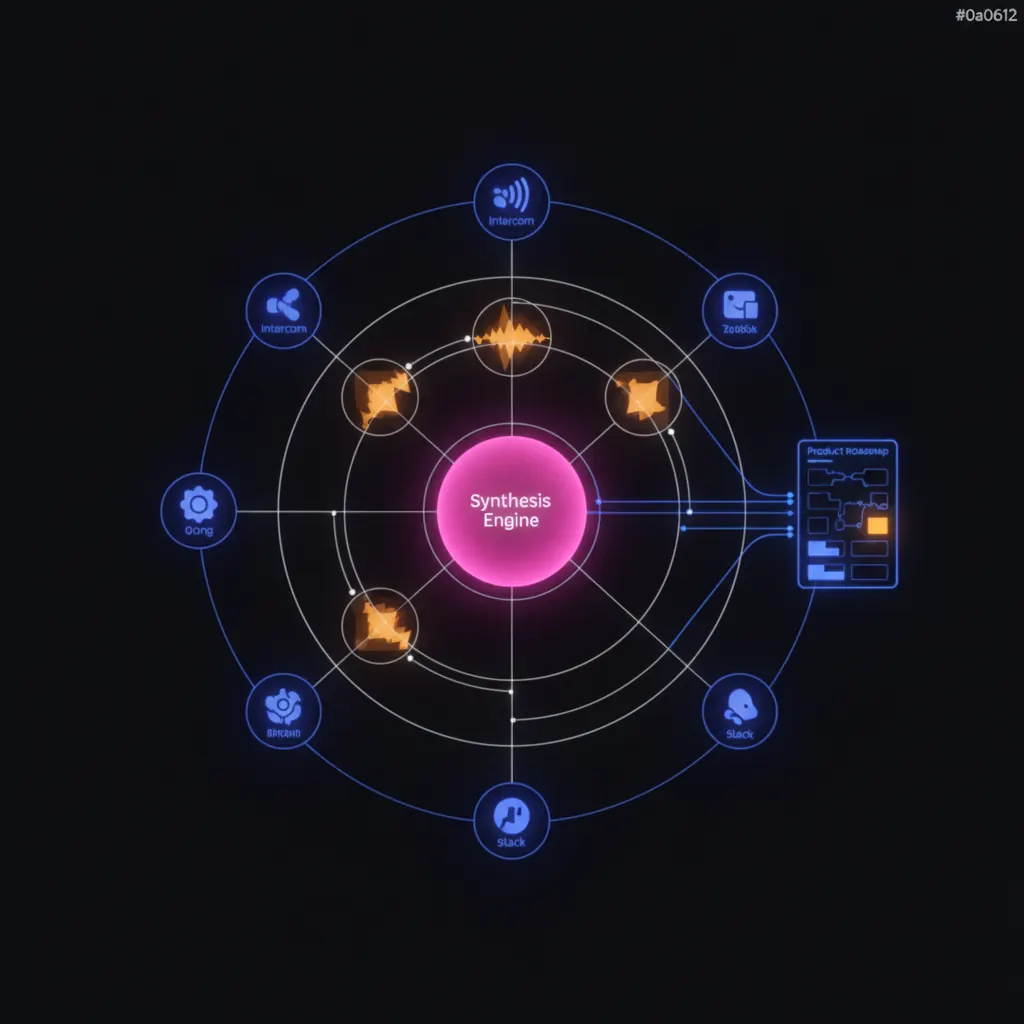
Hand the Productboard workspace, the Gong library, the Intercom conversation feed, the Zendesk ticket queue, the HubSpot lost-deal object, the #customer-feedback and #customer-wins Slack channels, and the Notion roadmap doc to a fractional AI agent. The agent does the work a product ops lead, a voice of customer analyst, and a research coordinator would do together. The cadence is per-signal on tagging, per-day on cluster updates, per-week on the ranked digest, and per-quarter on the roadmap brief.
Every Gong call tagged inside an hour of the recording. The July 29th enterprise call closes at 11:04 AM. By noon the agent has pulled the SSO request moment, tagged it against the existing SSO cluster, linked it to the $410K expansion opportunity in HubSpot, and posted a note in the account owner's Slack with the timestamped snippet and a proposed follow-up.
Every Intercom and Zendesk message tagged against a live taxonomy. A CS agent replies to a customer question about report exports at 2:18 PM. By 2:19 the agent has tagged the underlying export request, added it to the reporting cluster, and flagged that the cluster crossed the 25-signal threshold this week.
Every lost-deal note matched back to a roadmap gap. The head of sales files a July 22nd note on the $180K loss citing "auth requirements". By that evening the agent has parsed the note, matched it to the SSO cluster, updated the cluster's ARR-at-risk total, and posted the linkage in the CPO's Slack for a Monday review.
Every cluster ranked by ARR every Friday. Friday 5 PM the CPO gets a digest of the top 20 clusters, each ranked by ARR at risk plus ARR available, three source cites per cluster, a shipping-cost estimate from engineering hours, and a proposed decision (ship, defer, kill). The SSO cluster hits the top of the list at $2.1M ARR at risk against two engineer-weeks of build.
Every quarterly roadmap brief pre-drafted with linked evidence. The Q4 planning offsite opens October 1st. By September 15th the CPO opens a roadmap brief showing 34 candidate themes, ARR at risk on each, ARR available on each, a shipping-cost estimate, and a linked feedback trail with account names. The offsite spends two hours choosing from ranked evidence instead of debating from memory.
The unit economics of a 1,847-item queue
A Series B company at $22M ARR with 4,200 customers and 340 weekly feedback signals is burning three specific things. The CPO, the CS lead, the head of sales, the design lead, and the support lead spend a combined 10 to 16 hours a week on ad hoc triage, cluster arguments, and offsite prep against a fully loaded hour of $190 to $320. That is $8K to $20K a month of senior time on work a live agent clears. The CPO gets four to seven hours a week back inside the first sprint.
The shipping-mix line is the second one. Roadmap items shipped without a linked customer signal have a 2 to 4 times lower adoption rate in the first 90 days. On a team shipping 40 to 60 roadmap items a year with 30 to 50 percent carrying no linked signal, cutting the unlinked share to under 10 percent moves 8 to 20 items a year from low-adoption to high-adoption shipping. Each high-adoption ship maps to 3 to 8 expansion conversations the renewal book picks up before the next quarter.
The lost-deal line is the third. Cutting the time from first signal to roadmap decision from 90 days to under 21 pulls two to five feature gaps a quarter out of the "cited in a lost deal" bucket. At a $180K to $410K average deal size in the mid-market and enterprise segments, that maps to $1.4M to $4.1M of pipeline defended a year. The inbound demo queue stops surfacing feature gaps the roadmap already knows about.
A 14-day sprint to stand up the agent runs in the low to mid five figures. Ongoing cost lands closer to a Gong seat than a product ops hire. Taxonomy build and tagging automation run in week one. Cluster ranking and the weekly digest run in week two. The first ranked digest lands in the CPO's Slack before the sprint closes.
What changes after the sprint
Picture the same Thursday, 10:24 AM moment, thirty days after the sprint ships. Your CPO opens Productboard. Feedback Inbox (214), 198 tagged, 16 in a fresh queue less than four hours old. She filters by "top cluster this week". The SSO cluster sits at the top, $2.1M ARR at risk, 34 signals across 19 accounts, three Gong snippets linked, two Zendesk threads linked, the July 22nd lost-deal note linked, an engineering estimate of two weeks, a design spec at the ready.
By Friday 5 PM she reads the weekly digest. Top 20 clusters ranked by ARR, three ship recommendations already carrying a design lead sign-off, six defer recommendations with a rationale, two kill recommendations with a citation trail. The Q4 offsite in six weeks opens against a roadmap brief that already ranks 34 themes with linked evidence. The design lead runs discovery on the two themes the CPO chose from the ranked list on Monday.
If your product backlog currently reads 1,847 items with 12 tagged this quarter, the version where every signal gets tagged inside an hour and the top cluster hits the CPO's Slack with $2.1M in ARR at risk cited is fourteen days away. Product feedback is a function. You can hire against it, you can retain a fractional product ops lead for it, or you can scope a sprint and have it running this month. The work is the same. The math is not.
 2026-09-16
Your Zapier Workspace Runs 340 Zaps. Ops Still Owns Every Exception.
Your Head of Ops opens Zapier Monday, 340 Zaps live, 47 tasks in the error queue, three broken since Thursday. A Zap is not an ops function.
 2026-09-14
Your BI Vendor Sold You 47 Dashboards. Reporting Is Something Else.
Your COO opens Looker Monday, 47 dashboards live, three exec inboxes waiting on the Q3 narrative. A dashboard is not a reporting function.
 2026-09-06
Your FP&A Model Has 34 Tabs and the CFO Rebuilds Q4 Forecast Every Friday Night
Your CFO opens the model Friday at 8:14 PM, 34 tabs, six broken links, 47 assumption cells hardcoded last quarter. A queue nobody staffed.