Your Zapier Workspace Runs 340 Zaps. Ops Still Owns Every Exception.
Your Head of Ops opens Zapier Monday, 340 Zaps live, 47 tasks in the error queue, three broken since Thursday. A Zap is not an ops function.

It is Wednesday, September 16, 8:04 AM. Your Head of Ops opens the Zapier workspace. 340 Zaps live across the org. 47 tasks sitting in the error queue since Sunday night. Three Zaps have been paused since Thursday because the HubSpot API changed a field name and the trigger stopped firing. The lead-routing Zap dumped 22 inbound demo requests into the wrong Slack channel over the weekend. Nobody noticed until the CRO pinged him at 7:47 AM asking why the pipeline dashboard showed zero net-new opportunities on Tuesday.
You bought Zapier at $599 a month on the Team plan and stacked n8n on top at $50 a workflow for the heavier lifts. The monthly automation spend now sits at $2,140. The pitch was that ops runs itself once the workflows are wired. What shipped is a workspace full of trigger-action chains that fire when a field changes and die when the field name shifts. Every exception routes back to your Head of Ops. Every broken Zap is his Monday morning. Every silent failure surfaces two days after the damage.
What a Zap is
A Zap is a trigger and a stack of actions. When a HubSpot deal moves to Closed Won, create a row in Airtable, send a Slack message to #wins, add the contact to a Mailchimp list, and fire a webhook to the finance workspace. Five steps. Linear. Deterministic. It runs when the trigger fires and does nothing when the trigger does not fire.
That is the entire product. Trigger, filter, action, action, action. Your Zapier workspace has 340 of those chains. Your n8n instance has 74 more with slightly better branching and a JavaScript step. The two workspaces sum to 414 automations across the ops footprint.
Not one of the 414 automations decides today is the day to re-check the 12 stalled deals in the pipeline. Not one of them reads the error queue at 8 AM Monday and works through the 47 failed tasks with the source record open. Not one of them picks up the phone when the HubSpot field rename breaks 14 downstream Zaps at once. A Zap fires. An ops function runs.
What ops owns
Ops owns the operating cadence of the business. It is the queue nobody else picks up. New signup fires without the lead-scoring Zap tagging it, ops writes the tag by hand. The invoice sync breaks over the weekend, ops rebuilds the six missed invoices on Monday. The onboarding Zap fires but the account manager assignment logic has not been updated since Q1, ops reroutes 34 accounts through the corrected map. The Head of Ops runs three of these fires before his 9 AM standup.
Every function inside your business has an ops layer between the tool and the customer. Sales ops chases the CRM hygiene the reps skip. RevOps rebuilds the quota model when the segmentation changes. FinOps reconciles the six systems that all count revenue slightly differently. People ops fixes the ATS-to-BambooHR handoff every time engineering hires a contractor on a non-standard offer template.
The pitch behind Zapier was that this layer disappears once the workflows are wired. Ten years of Zap workspaces suggest the opposite. The chains proliferate. The exceptions proliferate faster. Ops now owns 340 automation configurations plus the exception queue plus the 47 error tasks plus the three broken Zaps plus the human work the Zaps never covered.
Why the workflow tool stops working at Series B
At seed and Series A, Zapier is a force multiplier. Twelve founders, twenty-two Zaps, one Head of Ops who wrote them all and remembers what each one does. When a Zap breaks, he opens it, sees the trigger, sees the actions, fixes the field mapping, ships the change in six minutes. The tool pays for itself twelve times over on a Tuesday.
At Series B, the org has 47 tools in production, 340 Zaps written by nine people across three years, and a shared workspace where nobody knows which Zap owns which handoff. The Head of Ops from the Series A moved into RevOps. The new operator inherited the workspace with no documentation. Half the Zaps trigger on a field that a Salesforce admin renamed in Q2. A quarter of them depend on a Google Sheet nobody has opened since the launch of the new BI stack.
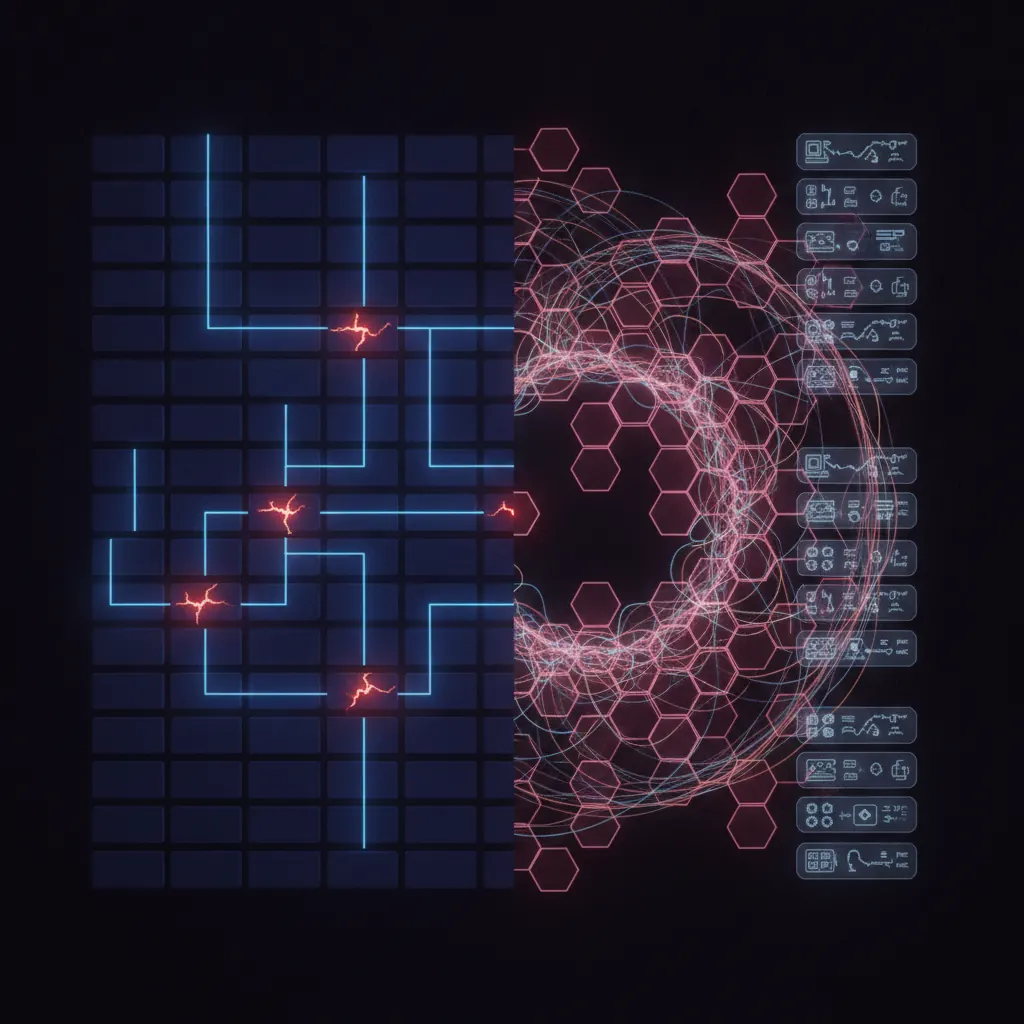
The workspace grew faster than the team documenting it. Every new Zap became a small piece of ops debt. Every field rename in a source system now cascades through eight to fourteen chains. The tool that saved twelve founders two hours a week is now the layer your Head of Ops spends 14 hours a week maintaining. The math flipped somewhere between the fortieth Zap and the two-hundredth.
What an agent stack does instead
An agent reads the source system, decides which action fits, and executes. It does not depend on a field name staying constant across a HubSpot release. It does not fail silently when a Google Sheet gets renamed. It reads the deal record, reasons about the state, and either takes the next action or opens a Slack thread with the ops operator when the state does not match any known playbook.
Take the lead-routing example. The Zap version filters on country and industry, routes into one of four Slack channels, and dumps the lead into the wrong channel when the industry field is empty. The agent version reads the lead's website, reads the LinkedIn page of the person who signed up, reads the last four inbound demo requests from the same domain, decides the account is Series C fintech based in London, routes to the enterprise EMEA channel, and logs the reasoning in a thread the AE can audit. When the reasoning is thin, it pauses and pings the ops operator with the record and a suggested route.
The chain stopped being a linear if-this-then-that. The function reads, reasons, and acts. The exception queue shrinks because the agent handles the ambiguous cases the Zap dumped into the error tab. The Monday morning triage list drops from 47 tasks to under 8. The three chronic broken Zaps that ate a day a week become a resolved thread in the ops channel with a source record attached.
The unit economics of the trade
Path A keeps Zapier and n8n at $2,140 a month, hires an Ops Manager at $135K loaded to own the workspace, and adds a Senior Ops Analyst at $155K loaded in Q4 when the exception queue crosses 80 tasks a week. Year-one incremental spend lands $315K. The 340 Zaps still break every time a source system pushes a schema change. The Ops team still owns Monday mornings. The workspace still grows by twelve Zaps a quarter with no owner assigned.
Path B keeps Zapier for the twenty Zaps that are still deterministic and cheap to run, kills the other 320, runs a 14-day sprint to stand up an agent stack against the four ops cadences that generate 80 percent of the exceptions, and runs at $5K to $9K a month on API spend and tooling plus a fractional ops operator at $4K to $6K a month who owns the exception loop. Year one lands $130K to $190K on three owned cadences. The error queue drops from 47 tasks Monday morning to under 8. The Head of Ops closes his laptop at 6 PM on Fridays.
The three questions to run against every Zap in the workspace this quarter
Which cadence runs because of this Zap? Name the trigger, the frequency, the downstream owner, and the exception window. If the answer is "this Zap fires when a field changes and we hope the downstream tool picks it up," the Zap is a fragile pipe, not a function. The renewal cycle deserves a two-column audit before the next Zapier invoice signs off.
Which exception ships to a human when this Zap fails? Name the routing rule, the owner, and the response window. If the exception drops into the Zapier error tab and gets read on Monday morning, the failure mode is silent for 72 hours. That is not automation. That is deferred manual work assigned to whoever opens the tab first.
Which reasoning does this Zap do that a field-mapping rule cannot express? If the Zap is a filter and five actions, it is a pipe. If the Zap depends on a human reading the record and deciding what to do next, the work belongs in an agent, not a chain. Every Zap in the third bucket is a candidate for the sprint.
If your Head of Ops is opening the Zapier error tab this morning, the version where the ops cadence runs without him is fourteen days away. Zaps are pipes. Ops is a function. You can hire a second ops manager, keep expanding the workspace, or scope a sprint and read the first exception queue drop in the ops channel next weekend.
 2026-09-14
Your BI Vendor Sold You 47 Dashboards. Reporting Is Something Else.
Your COO opens Looker Monday, 47 dashboards live, three exec inboxes waiting on the Q3 narrative. A dashboard is not a reporting function.
 2026-09-06
Your FP&A Model Has 34 Tabs and the CFO Rebuilds Q4 Forecast Every Friday Night
Your CFO opens the model Friday at 8:14 PM, 34 tabs, six broken links, 47 assumption cells hardcoded last quarter. A queue nobody staffed.
 2026-09-05
Your Product Analytics Tracks 340 Events and PMs Open Mixpanel Twice a Month
Your PM opens Mixpanel Thursday, 340 tracked events firing, two dashboards bookmarked, last query ran August 14. A queue nobody staffed.