The 11-Hour Day of a Series B COO
A Series B COO spends 11 hours a day stitching six functions by hand. The agents close the queue. The COO lands on four decisions a week.
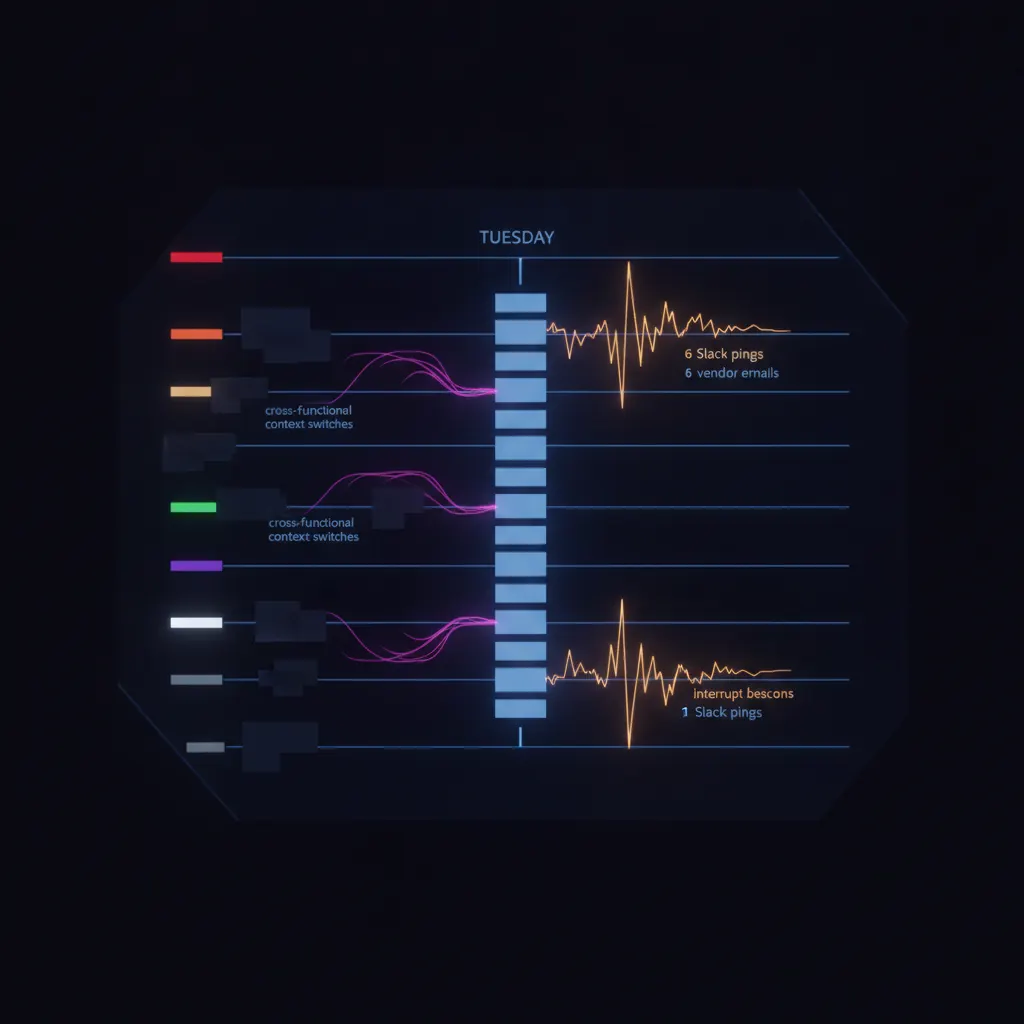
It is Tuesday, 7:42 AM. Your COO opens the laptop before the kid is out the door. 18 Slack pings from the overnight on-call, four red flags on the Monday close that Finance queued at 11:48 PM, two vendor-renewal emails from the GC with a Thursday deadline, one Series B investor update draft from the CEO sitting at 42 percent complete, and a 9:00 AM standup with the engineering lead whose roadmap commit slipped three weeks for the second quarter running. The day has not started. The queue has.
By 6:38 PM the COO has run 11 hours of calendar, taken 42 context switches, written 2,100 words of email, and shipped two decisions. The six functions reporting into the seat each got 48 minutes of attention. The CEO asks in the Thursday executive sync why the Q4 commit-hit rate is 61 percent. The COO has an answer. It took the whole 11 hours to build it.
What the 11 hours looks like
Every Series B COO reading this knows the shape. The seat spans finance ops, revenue ops, marketing ops, customer support, hiring ops, and legal ops. Six functions, one calendar, and the executive brief the CEO reads before the board call. The scope reads strategic. The reality reads queue triage.
Morning stand-up block, 9:00 to 10:30 AM. Three function syncs stacked back to back. Engineering commits slipped on two of three design-partner features. Support ran 61 percent SLA attainment last week against a 90 percent target. Marketing shipped three campaigns against a seven-campaign commit. Each sync produces four action items for the COO. Twelve action items by 10:30 AM.
Mid-morning synthesis block, 10:30 AM to 12:30 PM. The COO reads the six function dashboards, writes a 480-word slice of the Thursday executive brief, pings four function heads for the metric they forgot to update, and takes two inbound DMs from the CFO about the Monday close. The brief reads 22 percent complete at noon. The synthesis reads thin on three of six functions because the dashboards store numbers and the brief needs sentences.
Lunch calendar hold, 12:30 to 1:00 PM. Lunch becomes a 12-minute reheat and three Slack replies. The hold shows green on the shared calendar. Nobody is fooled.
Afternoon decision block, 1:00 to 4:00 PM. Three one-to-ones with function heads. Each surfaces four blockers the function head needs the COO to unstick. Twelve blockers. The COO writes 11 responses by end of day and defers one to Wednesday.
End-of-day review, 4:00 to 6:30 PM. The COO reads the Monday close exceptions, drafts the response to the two vendor renewals, writes 320 words of the Series B investor update, and pings the engineering lead about the roadmap slip. The investor update reads 54 percent complete at 6:30 PM. The context on the slip reads second-hand through a Slack thread.
What the executive brief should hold on Thursday
The CEO reads the Thursday executive brief for four things. The six function metrics against commit. The three cross-function dependencies most likely to miss the quarter. The two decisions the COO is asking the exec team to make this week. The one risk escalating to the board pack.
That brief is a two-hour write for a well-rested operator with the six function metrics already synthesized. In the live Series B calendar, the brief gets 90 minutes between the 1:00 PM one-to-ones and the 4:00 PM close review, with 11 context switches during the write. The output reads thin on three of six functions and the two cross-function dependencies land in the Q&A instead of the memo. The CEO notices. The board notices on the following read.
The gap is not COO quality. The gap is 11 hours of queue work the stack was supposed to run on its own and does not. The six dashboards show numbers. Reporting is the function that ships the Thursday brief with the three cross-function dependencies pre-cited. The six function heads own the queue. Nobody owns the synthesis.
What the six agents close by Friday
A fractional AI department stands up six agents against the six functions and routes the synthesis into one Thursday executive brief. Each agent reads against its function's system of record and ships a Monday-through-Friday cadence of briefs. The COO reads six briefs by 8:30 AM and lands on the four decisions a week that move the ledger.
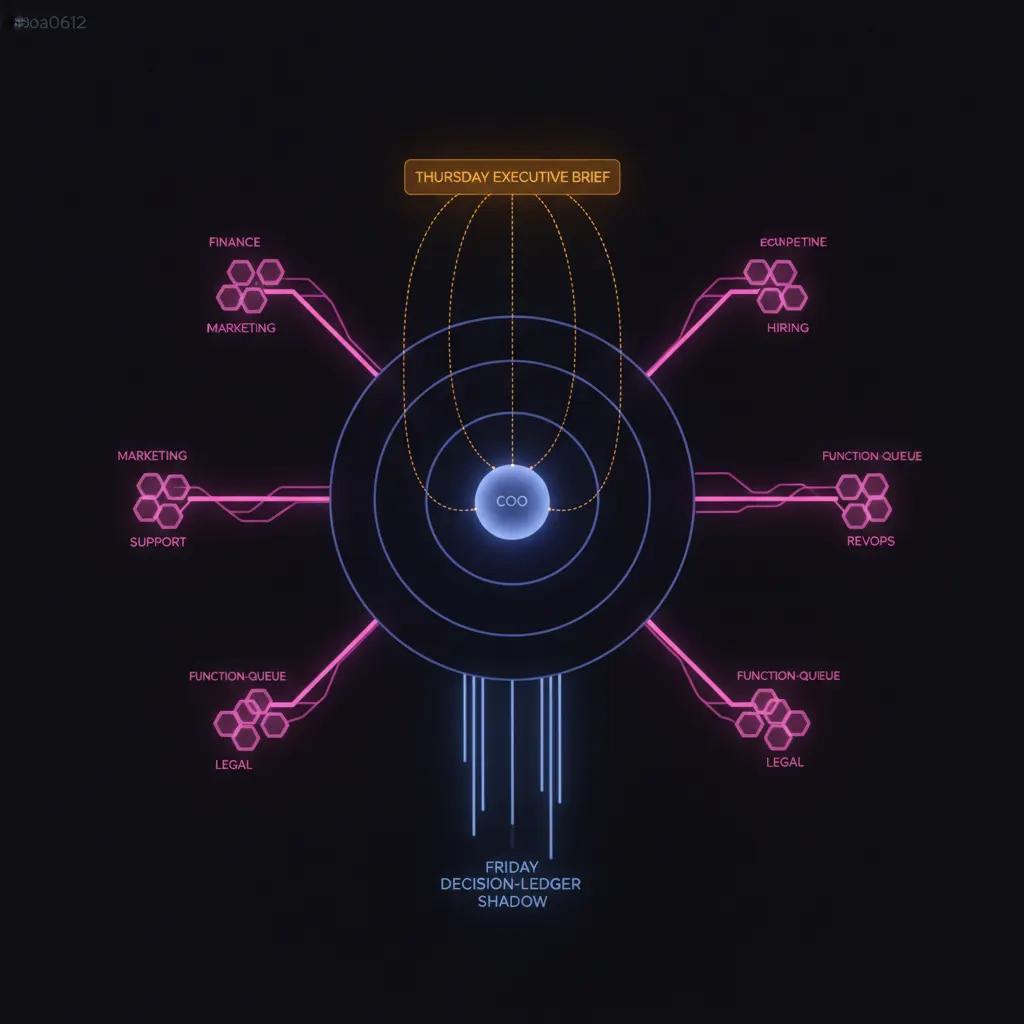
Finance Ops agent. Clears the 42 reconciling items by day five, drafts the flux brief by day seven, and ships a signed trial balance on day eight. The CFO reads the exception list at 8:09 AM Monday instead of 11:48 PM Monday.
RevOps agent. Reads the 240 open opportunities, routes the 42 stuck past the stage SLA, and ships the Monday pipeline brief with the three deals most likely to slip the quarter pre-cited.
Marketing Ops agent. Owns the 42 live campaigns, tags the 28 untagged ones, and ships the Thursday CMO brief with channel mix cited against the seven-campaign commit.
Customer Support agent. Triages the 420 open tickets, drafts SLA-safe replies, and ships the Monday CX brief with deflection and backlog cited against the 90 percent target.
Hiring Ops agent. Reads 240 candidates across 11 reqs, drafts the Monday scorecard brief, and ships offer-ready handoffs by 8:00 AM.
Legal Ops agent. Reads 240 live contracts, flags the 42 auto-renewing in 60 days, and ships the Thursday counsel brief by 8:00 AM. The two vendor renewals that ate the Tuesday afternoon land on the Monday brief with the counterparty position already cited.
The unit economics on the seat
A Series B COO reads $320K to $420K loaded against the US entity. 32 to 44 hours a week on queue work across the seat and the six function heads costs the company $380K to $720K a year in senior time on work the systems of record were supposed to run on their own.
A 14-day sprint to stand up each function agent runs in the low to mid five figures. Six sprints staged across a quarter land at mid six figures of one-time spend. Ongoing cost lands at $18K to $42K a month across the six agents on API spend, read access, and the ops operator who owns the Monday brief reviews. Year one lands at $400K to $700K against the $380K to $720K the function currently spends on senior time inside the queue. Year two drops to the ongoing line, so $220K to $500K against the same baseline. The COO and the six function heads land on the architecture and the strategy, which is what the ledger was paying them to run on in the first place.
What the sprint ships in 14 days
Day one, the agents read against the six systems of record. Day seven, the first Monday function briefs land in the six function-head inboxes with the exceptions routed. Day fourteen, the Thursday executive brief lands in the COO inbox at 8:00 AM with the six function synthesis, the three cross-function dependencies, and the two decisions pre-staged for the exec team.
If your Tuesday starts at 7:42 AM and ends at 6:38 PM with 11 hours of calendar and two decisions shipped, the version where the Thursday brief lands at 8:00 AM and the COO owns the four decisions a week that move the ledger is fourteen days per function away. The dashboards still show the numbers. The systems of record still store the data. The agents close the function the stack was already supposed to close. You can keep running the Monday close on an 11:48 PM Slack ping, or you can scope a sprint and have the Thursday executive brief landing before the next board pack.
 2026-10-27
Your Linear Is Not Engineering Management
Linear tracks 2,400 tickets. Engineering management is the function that ships the 94 that move the roadmap on cadence with blockers cleared.
 2026-10-26
What a Fractional AI Data Ops Agent Does
A fractional AI Data Ops agent reads 420 dbt models, drafts the Thursday metric brief, and ships the broken-model exception list by 8:00 AM Monday.
 2026-10-22
What a Fractional AI Finance Ops Agent Does
A fractional AI Finance Ops agent clears the 42 reconciling items, drafts the day-five flux brief, and ships a signed trial balance on day eight.