Your Zendesk Is Not Customer Success
Zendesk closes 4,200 tickets a quarter. Customer success is the function that lands 42 accounts on the renewal signed and the expansion already drafted.

It is Tuesday, 4:11 PM. Your Head of Customer Success opens the renewal queue for Q1. 42 accounts worth $8.4M in ARR renew in the next 90 days. 11 of them have logged under 14 active sessions in the last 30 days. Zendesk reads those 11 accounts as green, because Zendesk only sees three low-severity tickets from each, two of them "feature request" and one "how do I export a CSV." The CSM assigned to the largest of the 11, a $420K account, pings the champion on Thursday at 2:40 PM. The champion left in September. The replacement has been running a pilot of the competitor since October 14. The deal reads for non-renewal on day 47 of the renewal cycle and the forecast shipped to the CRO on day one said closed-won at 92% probability.
Every Series B customer success function we audit reads the same shape. Zendesk closes the tickets. A human reads the churn signal. The tool is the queue. Customer success is the function that owns the 42 renewals, the 11 at-risk accounts, and the $8.4M in ARR that the board model prices at 118% net retention.
What Zendesk stores vs what the function owns
Zendesk closes 4,200 tickets a quarter against 420 customer accounts. It reads a median first response of 42 minutes, a CSAT of 91, and a deflection rate of 36% on the help-center bolt-on. It is excellent at what it does. It routes the ticket, applies the SLA, and files the resolution. It does not know that the account that opened two tickets this quarter stopped logging in after August 14. It does not know that the CTO who sponsored the deal in 2024 moved to the competitor in October. It does not know that the $420K renewal three weeks out carries a usage curve that fell 68% from Q3 to Q4.
Customer success is the function that reads those signals on cadence. It owns the 42 Q1 renewals, the 11 flagged for churn risk, the 14 priced for expansion, and the NRR number the CFO cites on the board deck. It reads against six systems, not one. Zendesk for ticket volume, the product telemetry for usage, Salesforce for the renewal date and the ARR line, Gong for the last three champion calls, HubSpot for the marketing opt-out signal, and LinkedIn for the champion change. Zendesk is one of six inputs. The function is the synthesis.
The failure mode reads the same every time. The CSM runs the renewal queue in a spreadsheet pasted from Salesforce every Monday. The Head of CS rebuilds the health-score formula every quarter against a definition nobody owns. The CRO ships a renewal forecast to the board that reconciles on day 90 and the ARR waterfall drops 11 points in the final 14 days of the quarter. The board reads the gap at the Q4 review and asks why a $280K Head of CS is maintaining a Google Sheet on a Thursday night.
The 34-hour renewal cycle the tool does not run
A Head of CS at $220K runs $300K to $340K loaded. Three CSMs at $120K each run $160K to $185K loaded. The four seats spend 34 to 46 hours a week on account review and renewal prep against a queue the stack was sold as surfacing, and the queue reads the same four shapes every quarter.
Signal drift. 11 of the 42 Q1 renewal accounts read green in Zendesk and red in product telemetry. The CSM sees the Zendesk view first because Zendesk is the system of record for the CS org. 14 days of ticket-only review ships before the usage curve hits the renewal brief. Four of the 11 miss the save window.
Champion drift. 94 of the 420 customer accounts had a titled champion change in the last 180 days. 42 of those changes flowed through LinkedIn before anyone updated Salesforce. The CSM rediscovers the change on the renewal call. The new champion asks for a pilot extension and the renewal slips a quarter.
Expansion rot. 14 accounts a quarter log usage curves that price for a tier upgrade at $42K to $180K in incremental ARR. The CSM owns renewal on cadence and reads expansion as a stretch goal. 9 of the 14 renew flat and the CRO reads the gap against the net retention plan at month 11.
QBR cadence drift. The Head of CS owns the quarterly business review for the top 42 accounts. 11 of them slip past the 90-day cadence because the CSM is running the ticket queue on Thursday afternoon. Two of the 11 churn on their renewal anniversary citing "we never saw a QBR this year."
What the function ships on cadence
Monday. Account health ledger. The 420 customer accounts scored against ticket volume, usage curve, champion stability, pricing tier fit, and renewal distance. The 42 Q1 renewals pinned at the top with the risk band cited. The 11 red-flagged accounts routed to the owning CSM with the proposed save play drafted against the last three champion calls.
Thursday. Expansion brief. The 14 accounts whose usage curve prices for an upgrade in the next 60 days cited with the tier delta, the incremental ARR, and the proposed outreach draft. The Head of CS reads the brief at 8:09 AM Thursday and the exec sync opens with the expansion asks already drafted against the renewal cycle.
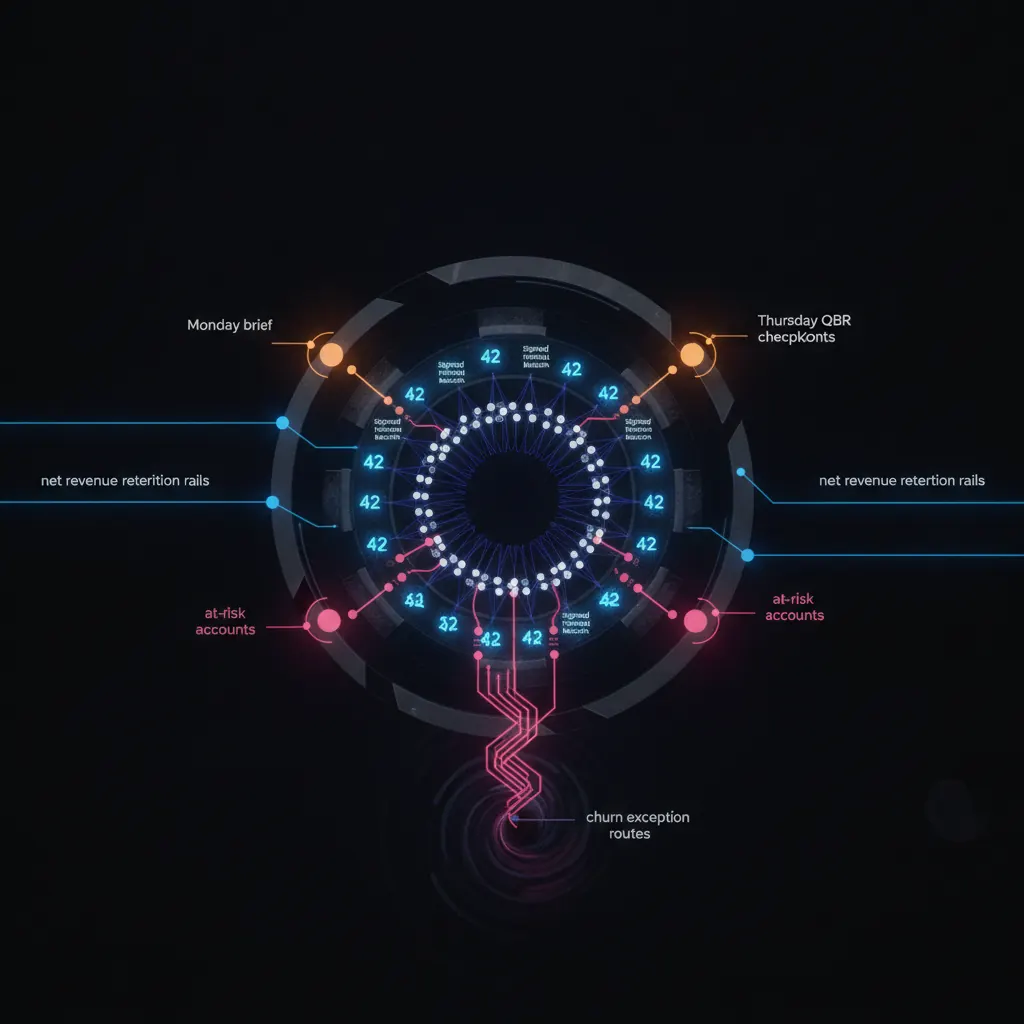
Weekly QBR ledger. The 42 top accounts carry a last-QBR date, a next-QBR cadence, and the three decisions the account expects to close at the review. The 11 accounts outside the 90-day cadence flagged with the slip reason and the proposed re-booking. The Head of CS signs the ledger before the Tuesday ops sync and the cadence holds against the renewal cycle.
Renewal forecast. The 42 Q1 renewals priced week over week against the five-signal health score. The forecast ships to the CRO on Monday at 8:00 AM with the probability band cited, the save plays routed, and the $8.4M in ARR reconciled against the renewal cycle to within three points by day 30 of the quarter.
Dispute and escalation routing. The 11 red-flagged accounts carry an escalation note with the Head of CS cited and the sponsor exec on the vendor side named. The two accounts most likely to auto-churn flagged with the save call pre-booked. The $220K to $420K of quarterly auto-churn retires against a queue the CRO reads at the Monday sync.
What a fractional AI customer success agent does on the stack
A fractional AI Customer Success agent reads against Zendesk, the product telemetry, Salesforce, Gong, HubSpot, and LinkedIn on day one. 4,200 tickets of the prior quarter, 180 days of usage curve against 420 accounts, the last 11 champion calls per top-42 account, and the 94 champion-change signals that flowed through LinkedIn in the last 180 days. The agent lands on the 42 Q1 renewals, the 11 at-risk, the 14 priced for expansion, and the five that read as save-and-upgrade candidates on the same call.
Week one, the agent ships the Monday health ledger with the 11 red-flagged accounts routed and the CSM running save plays instead of rebuilding a sheet. Week two, the Thursday expansion brief lands with the 14 upgrade asks drafted and the CRO reading the incremental ARR cited against the renewal cycle. Week three, the QBR cadence ledger clears the 11 slipped accounts and the next 42 reviews land on cadence. Week four, the renewal forecast reconciles against the $8.4M in Q1 ARR within three points by day 30.
The queue moves. The CSM calls. Write access sits on the Monday health ledger, the Thursday expansion brief, and the Monday renewal forecast only. Every save play and every expansion outreach routes through a human signoff before it ships. The Head of CS keeps the judgment calls and the quarterly strategy memo. The agent clears the queue that was stealing the calendar the save work was supposed to run on.
The unit economics on the function
A $220K Head of CS and three $120K CSMs read $780K to $900K loaded across four seats. 34 to 46 hours a week on account review and renewal prep at a loaded hour of $140 to $200 costs the function $140K to $280K a year on queue work Zendesk was sold as surfacing. Add the $220K to $420K a quarter in auto-churn the signal queue misses and the function reads $500K to $900K a year of senior time and settled ARR leaking against a tool line the board reads as a CS line.
A 14-day sprint to stand up the agent lands in the low to mid five figures. Ongoing cost sits at $3K to $7K a month on API spend, read access against Zendesk, the product telemetry, Salesforce, Gong, HubSpot, and LinkedIn, and the Head of CS who signs the Monday renewal forecast. Year one lands at $55K to $110K against the $500K to $900K leak. Payback reads two to four months on the save plays alone and the stack keeps forecasting on day 30 into year two with no ramp drag priced in.
What the sprint ships in 14 days
Day one, the agent reads against Zendesk, the product telemetry, Salesforce, Gong, HubSpot, and LinkedIn. Day seven, the first Monday health ledger ships with the 11 red-flagged Q1 renewals routed to the owning CSM and the save plays drafted. Day fourteen, the Thursday expansion brief lands at 8:09 AM with the 14 upgrade asks cited and the Monday renewal forecast scheduled to ship on cadence.
If your Zendesk closes 4,200 tickets a quarter and your Head of CS still discovers champion churn on the renewal call, the version where the Monday health ledger pins the 42 renewals at 8:00 AM with the 11 at-risk accounts routed is 14 days away. Zendesk still closes the tickets. The product telemetry still logs the sessions. The agent closes the function the stack was never going to close on its own.
You can keep running renewals on a Monday spreadsheet and watching the ARR waterfall drop 11 points in the final 14 days of the quarter, or you can scope a sprint and have the renewal forecast reconciled by day 30 against the next Q1 cut.
 2026-10-23
What a Fractional AI Customer Support Agent Does
A fractional AI Customer Support agent triages the 420 open tickets, drafts the SLA-safe replies, and ships the Monday CX brief with deflection cited.
 2026-10-07
Your Help Center Has 340 Articles and Six Were Updated This Quarter
Head of Support opens Zendesk Monday, 340 KB articles live, six updated this quarter, 94 flagged outdated by ticket data. A function nobody staffed.
- 2026-10-05
How ShakeGasm Leverages AI in Party Game Design in 2026
ShakeGasm uses AI as a game-design co-pilot, generating ruleset variants for phone-sensor party games. Here is how consumer-fun apps use AI differently.