What a Fractional AI Customer Support Agent Does
A fractional AI Customer Support agent triages the 420 open tickets, drafts the SLA-safe replies, and ships the Monday CX brief with deflection cited.
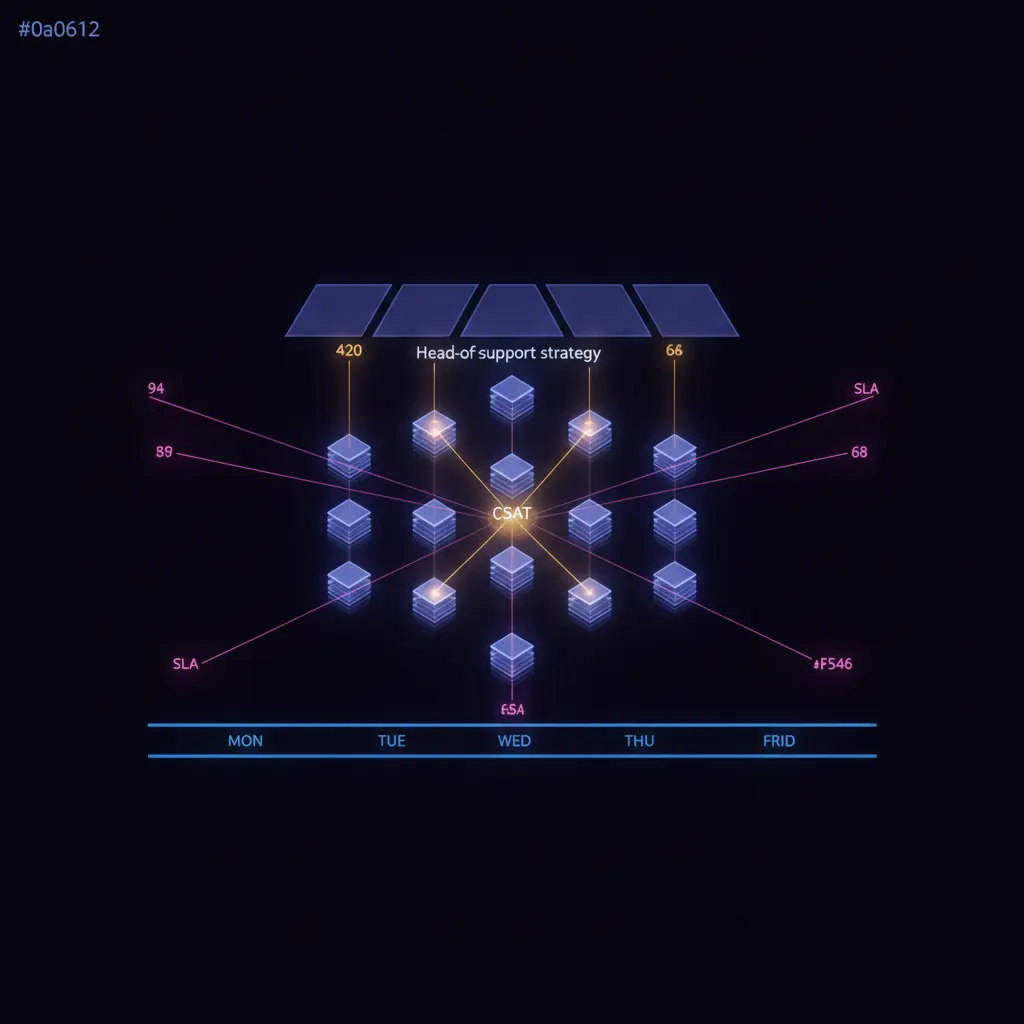
It is Monday, 7:48 AM. Your Head of Support opens the agent inbox before the standup. A 340-word brief sits at the top of the queue. 420 open tickets across three regions, 68 past the 24-hour first-response SLA, 94 flagged as repeat intent against the top 11 KB articles, 42 billing escalations routed to the Finance Ops queue overnight, the draft replies staged against the 180 Tier-1 tickets with a one-click send ask to the three team leads, and the Friday CSAT brief queued against the Q4 target. The 9:00 AM support standup opens with the SLA list already cleared.
Three quarters ago, the same Monday read differently. The Support Ops lead opened Zendesk at 7:48 AM, pulled a weekend backlog report, chased three team leads in Slack for the overnight escalations, hand-tagged 42 billing tickets to Finance, and walked into the 9:00 AM standup at 9:12 AM with half the queue triaged and no answer on the 68 SLA breaches sitting against the enterprise accounts. 48 hours of weekend chase bought the function one Monday standup. The agent shipped the triage, the draft replies, and the escalation route by 7:48.
What the function was supposed to own
A Customer Support Ops lead sits at the junction of five systems. Zendesk or Intercom on the ticket side, the help center on the KB side, Slack on the escalation side, Salesforce on the account side, and the product telemetry feed on the bug side. The job description reads first-response SLA, resolution SLA, CSAT, deflection rate, and the quarterly QBR read on cost per contact. The reality reads 40 hours a week on tag hygiene and macro drafting, four hours a week on the Friday CSAT brief, and one QBR a quarter where the cost-per-contact question gets answered against stale KB coverage.
The help-center queue is a function with a cadence. 420 tickets, 11 top intents, three regions, and six team leads. The queue runs on a daily rhythm because the enterprise accounts read a 24-hour first-response SLA and the executive dashboard reads a weekly CSAT trend. The hygiene work sits between the operator and the decision work, and the hygiene work eats the week.
What the agent runs against on day one
The agent reads against Zendesk or Intercom for the ticket objects, the help center for the KB article content and last-updated timestamp, Salesforce for the account tier and renewal date, Slack for the engineering escalation threads, and the product telemetry feed for the bug reproduction signals. The read layer sits inside the systems the Support Ops team already works in. The brief sits inside the operator inbox the team already checks before coffee. No new tool goes on the stack.
Intent-tag pass. The agent reads the 420 open tickets against the taxonomy, cites the 94 repeat-intent tickets against the top 11 KB articles, flags the 42 billing escalations against the Finance Ops lane, and routes the Monday tag ask to the three team leads. The 40-hour weekly tag chase drops to a 15-minute morning review of the exception list. The three team leads read a ranked exception list instead of a shared tagging spreadsheet.
Draft-reply pass. The agent reads the 180 Tier-1 tickets against the macro library and the per-account history, drafts the SLA-safe reply against the account tier and the sentiment signal, cites the one-click send ask against the three team leads, and routes the four Tier-2 asks to the senior agents by name. The median first response that used to land at 4 hours and 14 minutes closes to 38 minutes on the Tier-1 lane. The senior agents stop drafting the fifth version of the password-reset macro.
KB-gap brief. The agent reads the 94 repeat-intent tickets against the top 11 KB articles, cites the four articles updated inside the last 90 days against the seven cited by ticket data as outdated, drafts the per-article refresh ask against the content owner, and routes the Friday deflection ask with the expected ticket-volume drop priced in. The 340-article help center the Head of Support flagged in September reads a per-article refresh queue inside the first sprint. The content owner reads a ranked ask against ticket data instead of a quarterly audit meeting.
What the agent ships on cadence
Monday 8:00 AM. SLA breach brief. 68 past the 24-hour first-response SLA, per-region owner cited, Tuesday fix routed, the 11 enterprise-tier tickets flagged against the account owner and the AE for the Monday save.
Tuesday 8:00 AM. Escalation audit. The 42 overnight escalations against the Finance Ops queue, the 11 against the Engineering bug queue cited per telemetry signature, the four against the Trust and Safety queue routed per policy flag, the per-queue ask routed with the owner cited by name.
Wednesday 8:00 AM. Deflection reconciliation. The 94 repeat-intent tickets against the top 11 KB articles, seven articles cited as outdated by ticket data, the per-article refresh ask routed to the content owner, the Friday deflection brief queued with the expected ticket-volume drop priced in.

Thursday 8:00 AM. CSAT trend brief. The weekly CSAT against the Q4 target, the three accounts carrying 42 percent of negative sentiment cited by AE, the two intents driving the Tier-1 CSAT drop against the per-intent macro, and the Friday ask routed before the executive dashboard refresh. The brief that used to land Thursday night at 8:08 PM ships Thursday morning at 8:00 AM.
Friday 8:00 AM. Weekly CX brief. The 420 opened against the 380 closed, the 68 SLA breaches cleared against the Monday route, the deflection shift against the seven refreshed KB articles, the cost-per-contact against the quarterly target, and the four strategy asks ranked by expected ticket-volume movement. The Head of Support reads the brief at 8:08 AM and the executive dashboard refresh at 10:00 AM opens with the numbers already cited.
What the operator does with the hours back
The 32 to 40 hours a week the agent clears land on four decisions. The macro library refresh against the Q3 CSAT variance. The KB coverage shift against the seven outdated articles cited by ticket data. The enterprise-tier escalation policy against the five accounts the AE flagged in September. The Tier-2 staffing plan against the per-region volume curve. The function reads a Monday brief and ships four decisions by the Friday CX brief. The queue runs on cadence.
The Head of Support stops asking the Ops lead for the number. The number is already in the brief. The Ops lead stops being the tag person and starts being the policy person. One operator owns the Monday review per region, the agent clears the queue, and the Friday CX brief opens with the SLA list cleared, the deflection drafted, and the executive dashboard numbers already cited.
The unit economics on the function
A $140K to $180K Support Ops lead reads $190K to $240K loaded against the US entity. 40 hours a week on tag hygiene and macro drafting at a loaded hour of $65 to $120 costs the function $130K to $240K a year in senior time on queue chase, escalation routing, and the Friday brief draft. A 14-day sprint to stand up the Customer Support agent runs in the low to mid five figures. Ongoing cost lands at $2K to $6K a month on API spend, Zendesk and Salesforce read access, and the operator who owns the Monday review.
Pull the same math against a second Support Ops hire. The $160K base reads $210K to $240K loaded, 90-day ramp, 180-day replacement risk if the hire bounces. The sprint-versus-hire math lands two to five times cheaper on year one for the queue work. The current Ops lead stays on the plan and lands on the policy work. The second hire gets replaced with a sprint. The $210K line clears to the KB coverage sprint above the queue.
What the sprint ships in 14 days
Day one, the agent reads against Zendesk or Intercom, the help center, Salesforce, the Slack escalation channels, and the product telemetry feed. Day seven, the first Monday SLA brief lands in the operator inbox with the 68 breaches routed to the three team leads. Day fourteen, the Friday CX brief lands at 8:00 AM with the deflection shift, the cost-per-contact, and the four strategy asks cited. Day fifteen, the function sits on the same cadence it will run every week for the next two years. One operator owns the Monday review per region. The agent clears the queue.
If your Monday reads 68 SLA breaches and the Head of Support is still asking which KB articles to refresh, the version where the brief lands at 8:00 AM and the Ops lead owns the deflection call is fourteen days away. Zendesk still stores the tickets, the help center still stores the articles, and Salesforce still stores the account tier. The agent closes the queue the stack was already supposed to close. You can keep running the Monday standup on a weekend backlog report, or you can scope a sprint and have the Friday CX brief landing before the next executive review.
 2026-10-07
Your Help Center Has 340 Articles and Six Were Updated This Quarter
Head of Support opens Zendesk Monday, 340 KB articles live, six updated this quarter, 94 flagged outdated by ticket data. A function nobody staffed.
- 2026-10-05
How ShakeGasm Leverages AI in Party Game Design in 2026
ShakeGasm uses AI as a game-design co-pilot, generating ruleset variants for phone-sensor party games. Here is how consumer-fun apps use AI differently.
 2026-10-02
Your Customer Onboarding Takes 94 Days and 27% Churn Before Second Invoice
VP CS opens implementation tracker, 34 accounts, oldest 148 days post-kickoff, 27% churn before second invoice. Onboarding is a function you never staffed.