Your Salesforce Is Not Pipeline Management
Salesforce stores 240 opportunities. Pipeline management is the function that lands 11 AEs on the three deals that close the quarter against the commit on cadence.
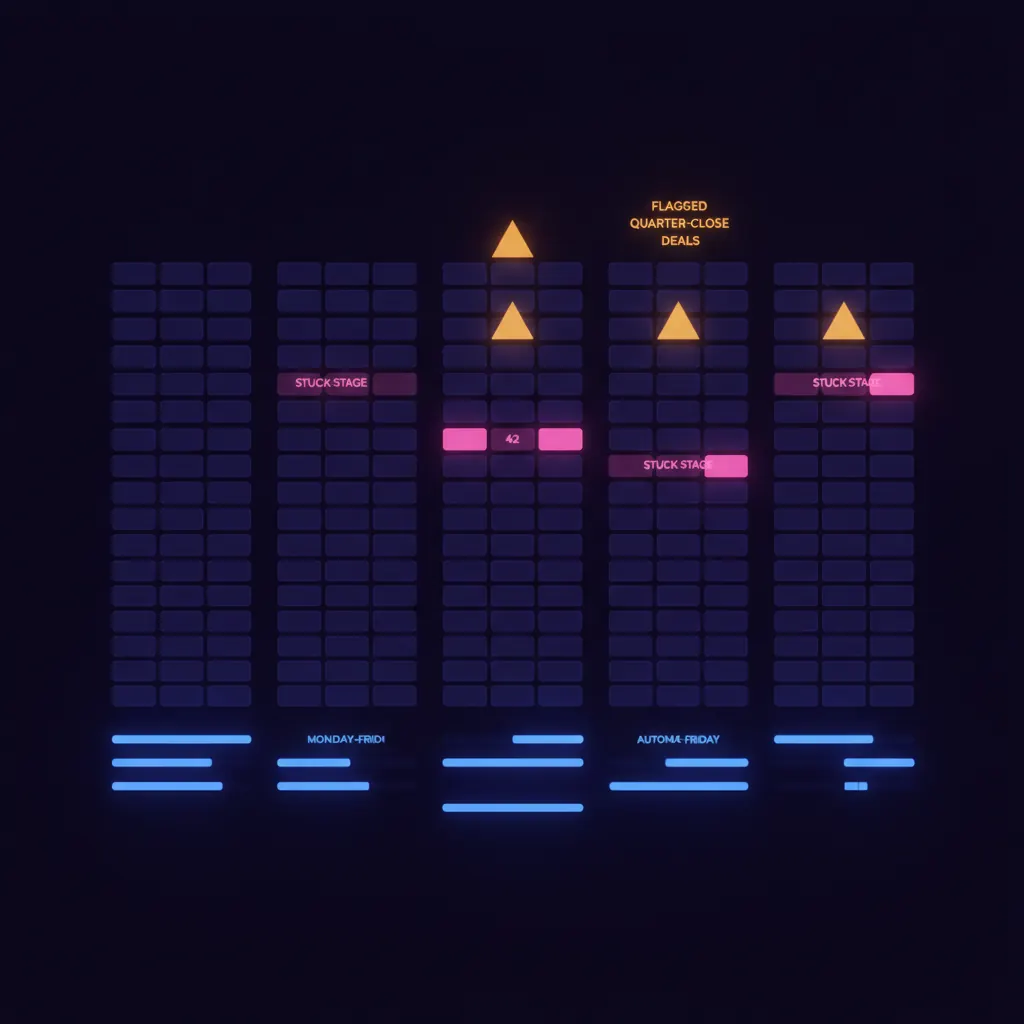
It is Monday, 8:14 AM. Your VP Sales opens Salesforce before the 9:00 AM pipeline call. 240 open opportunities across six stages, 42 of them untouched for more than 21 days against a stage SLA of 14, 61 with a close date in the past that nobody has nudged forward, 94 with a next step field reading "follow up" verbatim, and the Q4 commit sitting at 68 percent to coverage against a 300 percent target. The VP opens the summary report, filters to deals above $100K, sorts by close date, and walks into the 9:00 AM. The three deals the VP will cite are 1.3 percent of the shelf. The commit ships against the other 98.7 percent.
Every operator who confuses Salesforce with pipeline management is quoting the wrong tool. Salesforce is a database of record with a workflow engine on top. It stores the record. It does not run the function.
What Salesforce stores vs what the function owns
Salesforce stores 240 open opportunities, 1,840 contacts, a stage definition last revised at Series A, and 68 custom fields nobody has audited since the last RevOps hire left. Pipeline management is the function that lands 11 AEs on the three deals a week that close the quarter, routes the 42 stuck past the stage SLA back into motion with the next step pre-cited, and ships the Monday pipeline brief with the two deals most likely to slip the quarter named with the owner and the ask.
The gap is not a Salesforce feature request. The function reads six systems. Salesforce for the record, Gong for the call transcripts, LinkedIn Sales Navigator for the buying-committee moves, the marketing automation tool for the account engagement signal, Slack for the deal-room chatter, and the email thread where the champion keeps replying to the AE's manager instead of the AE. Salesforce is one of six inputs. The function is the synthesis across them.
The 22 hours a week the sales team spends below the quota line
A $280K VP Sales reads $380K to $460K loaded against the US entity. 11 AEs under the seat each read $220K to $280K OTE at a loaded $300K to $380K. The scope reads quota attainment, forecast accuracy, and deal strategy. The lived calendar reads 22 to 30 hours a week on hygiene the CRM was supposed to run on its own.
Stage-SLA drift. 42 of 240 opportunities sit past the stage SLA with no activity in the last 21 days. The forecast still counts them in commit coverage. The Thursday pipeline review spends 40 minutes relitigating five of the 42 and the other 37 roll into the following week unmoved.
Next-step rot. 94 opportunities read "follow up" in the next step field verbatim. 61 read a close date in the past. The VP Sales cannot sort the pipeline on the two fields that would surface the real motion. The AE spends six hours a week updating fields to pass the Friday hygiene audit, and the hygiene audit still ships at 71 percent compliance.
Deal-room signal. The Gong transcript on the top-three deal flagged a competitive mention three calls ago. The marketing automation tool shows the economic buyer visited the pricing page twice last week. Neither signal reached the AE's Monday prep. The VP learns both in the Thursday forecast call, 48 hours after the window to react closed.
Forecast reconciliation. The AE commit, the VP roll-up, and the CFO plan reconcile within four points on week one of the quarter and drift to 14 points by week six. Nobody owns the weekly reconciliation. The CEO sees the gap in the Thursday exec sync and the board sees it on the following read.
What the function should ship on cadence
Monday 8:00 AM. Pipeline brief. The 240 opportunities ranked against commit coverage day-of, the 42 past the stage SLA routed to the owning AE with the next step pre-cited from the last Gong call, the three deals most likely to close the week flagged with the ask, and the two deals most likely to slip the quarter named with the champion position and the proposed save play.
Tuesday 8:00 AM. Call-prep brief. The 24 scheduled calls read against the account signal, the four buying-committee moves surfaced from Sales Navigator, the three competitive mentions pulled from the last Gong transcript, and the two pricing-page visits flagged against the account owner. The AE reads the brief at 8:09 AM and the call opens with the ask pre-cited instead of a cold open.
Wednesday 8:00 AM. Pipeline-health brief. The 240 opportunities scored against stage-SLA compliance, the 94 "follow up" next steps rewritten against the last Gong transcript, the 61 past-dated close dates routed to the AE with the proposed new date, and the 68 custom fields scored for drift against the central dictionary.

Thursday 8:00 AM. Forecast brief. The AE commit, the VP roll-up, and the CFO plan reconciled on the same cut of data, the three accounts most likely to slip the quarter flagged with the renewal or close date and the owner, the two expansion deals ranked by expected close value, and the one deal where the champion is replying to the AE's manager flagged for the VP to escalate.
Friday 8:00 AM. Weekly review brief. The 11 AEs scored against the trailing 60-day stage-SLA attainment, the two deal archetypes most likely to recur the following week pre-staged with the play, and the four decisions ranked for the following week by expected revenue movement. The VP Sales reads the brief at 8:09 AM and the Monday pipeline call opens with the ask already drafted.
The unit economics on the function
A $280K VP Sales reads $380K loaded. A RevOps lead at $240K reads $320K loaded. 22 hours a week on hygiene and reconciliation across the two seats at a loaded hour of $160 to $240 costs the function $180K to $280K a year on queue work the CRM was supposed to run. The quarterly new-ARR commit sits in the $3M to $6M range. One point of commit missed because the forecast reconciliation drifted is $30K to $60K a quarter and a board conversation nobody wants to have.
A 14-day sprint to stand up the pipeline synthesis agent runs in the low to mid five figures. Ongoing cost lands at $3K to $7K a month on API spend, read access to Salesforce, Gong, Sales Navigator, and the marketing automation tool, and the RevOps operator who owns the Monday brief review. Year one lands three to five times cheaper than the next RevOps hire. The VP Sales and the 11 AEs stop running the hygiene queue and land on the deal strategy and the quota work the ledger was paying them to run on in the first place.
What the sprint ships in 14 days
Day one, the agent reads against Salesforce, Gong, Sales Navigator, and the marketing automation tool. Day seven, the first Monday pipeline brief lands in the VP Sales inbox with the 42 stuck-stage opportunities routed and the three slip-risk deals cited. Day fourteen, the Thursday forecast brief lands at 8:00 AM with the AE commit and the CFO plan reconciled and the Friday review brief sitting on cadence.
If your Salesforce reads 240 opportunities, 42 of them stuck past the SLA, and the Monday pipeline call still opens on three deals cited from a sorted report, the version where the brief lands at 8:09 AM is fourteen days away. Salesforce still stores the record. Gong still holds the transcripts. The agent closes the function the stack was already supposed to close. You can keep running the Monday pipeline call on a filtered report, or you can scope a sprint and have the Friday review brief landing before the next board read.
 2026-10-30
Your Gong Is Not Sales Coaching
Gong stores 1,840 calls. Sales coaching is the function that lands 11 AEs on the three skill reps that close the quarter with the plan on the ledger.
 2026-10-24
What a Fractional AI SDR Agent Does
A fractional AI SDR agent researches the 1200 target accounts, drafts the sequence replies, and ships the Monday pipeline brief with meetings booked cited.
 2026-10-20
A Week in the Life of a Head of RevOps After the Agent
Before the agent, the RevOps lead spent 34 hours chasing 240 deals. After the sprint, the Monday brief lands at 8:00 AM with the ask drafted.