Your Gong Is Not Sales Coaching
Gong stores 1,840 calls. Sales coaching is the function that lands 11 AEs on the three skill reps that close the quarter with the plan on the ledger.

It is Monday, 8:12 AM. Your VP of Sales opens Gong before the pipeline review. 1,840 recorded calls across the trailing 30 days, 320 of them unreviewed, 42 deals flagged on a stuck stage, 11 AEs on the roster, and a Q4 commit sitting at 71 percent to goal with eight weeks on the clock. The VP opens three calls at random, writes two Slack notes to the two AEs she liked the most on Friday, and heads into the 9:00 AM forecast call. The three calls she sampled are 0.16 percent of the week. The 11 AEs will close the quarter against the other 99.84 percent.
Every RevOps lead who confuses Gong with sales coaching is quoting the wrong tool. Gong is a brilliant call-recording and conversation-intelligence library. It stores the tape. It does not run the function.
What Gong stores vs what the function owns
Gong stores 1,840 calls, 42 trackers, a deal-risk score on 240 open opportunities, and a scorecard template nobody has filled out since Q2. Sales coaching is the function that lands each of the 11 AEs on the three skill reps that move their individual quota attainment, keeps the Monday one-to-ones running against a written development plan, and ships the quarterly ramp report with the before-and-after cited on the ledger the CRO reads at the board meeting.
The gap is not a Gong feature request. The function reads six systems. Gong for the conversation data, Salesforce for the stage-fit and deal-value signal, the enablement wiki for the current playbook, the AE scorecard for the trailing 90-day skill baseline, the forecast call notes for the deals the VP already sweated, and the Slack channel where every "quick save" lands between the Monday and Thursday pipeline reviews. The call library is one of six inputs. The function is the synthesis across them.
The 18 hours a week the VP spends below the quota line
A $240K VP of Sales reads $320K to $400K loaded against the US entity. The scope reads territory design, hiring, forecasting, exec-sponsor motion, and the quarterly ramp. The reality reads 18 to 26 hours a week on queue work the call library was supposed to run on its own.
Call sampling. 1,840 calls, maybe 24 sampled in a good week. That is 1.3 percent coverage across the 11 AEs. Three AEs got no coaching touch at all. One of them is the 42-percent-attainment AE the VP will put on a plan in six weeks.
Deal-risk triage. 42 flagged deals, maybe 11 opened by Thursday. The three that slipped the quarter all had a flag live for 14 days before anyone opened the call. The forecast narrative on the board call reads "late-stage slippage." The call tape reads "no economic buyer identified by stage three."
Scorecard rot. The scorecard template from Q2 still shows 11 AEs green on multithreading. The 90-day call data shows four AEs averaging 1.2 contacts per deal against a target of 3.0. The scorecard does not know. Nobody has reconciled it since the previous VP left.
One-to-one drift. Each AE gets 30 minutes a week with the VP. 22 of those minutes land on deal unsticks and forecast asks. The remaining 8 minutes are the "coaching." The development plan reads the same bullet it read in Q2.
What the function should ship on cadence
Monday 8:00 AM. Weekly coaching brief. 11 AEs ranked on quota pace against day-of-quarter, the two AEs trailing by more than 20 points flagged against the trailing 60-day call baseline, the three skill reps per AE pre-cited with the two call clips and the proposed drill, and the Monday one-to-one agenda drafted with the development-plan bullet carried forward from the previous week.
Tuesday 8:00 AM. Deal-risk brief. The 42 flagged deals ranked by expected ACV loss, the 11 with no economic buyer cited on the latest call flagged for the Thursday pipeline review, the eight with pricing pressure on the last two calls routed to the AE with the proposed concession ladder pre-cited, and the three on a stuck stage past 21 days routed to the VP for a save motion.
Wednesday 8:00 AM. Playbook reconciliation. The 240 open opportunities read against the current discovery template, the 94 missing one of the four required discovery fields flagged for the AE, the 42 playbook deviations from the trailing 30 days scored against win rate, and the two deviations that outperform the playbook flagged for enablement.
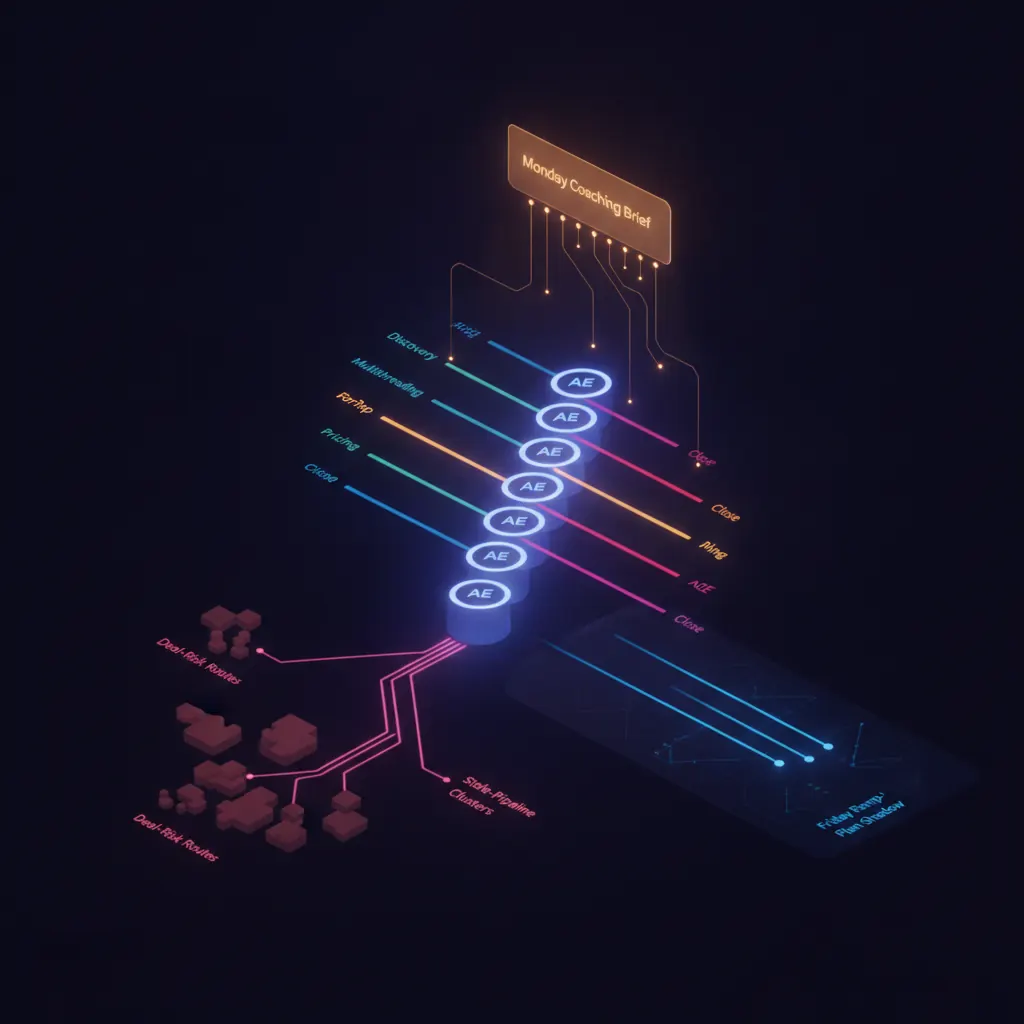
Thursday 8:00 AM. Forecast-grade brief. The 94 commit-and-upside deals ranked against the latest call signal, the 18 commit deals with a deal-risk score worse than the stage median flagged for the VP save motion, the six scope cuts logged against the quarterly commit ledger with the reason and the counterparty position cited, and the two outlier AEs flagged against the plan.
Friday 8:00 AM. Weekly ramp brief. The 11 AEs scored against the trailing 90-day skill baseline on discovery, multithreading, pricing, and close, the three skill reps most likely to move Q4 attainment, the two new-hire AEs tracked against the 90-day ramp curve, and the four decisions ranked for the following week by expected revenue movement. The VP reads the brief at 8:09 AM and the Monday one-to-ones open with the coaching ask already drafted.
The unit economics on the function
A $240K VP of Sales reads $320K loaded. A $180K enablement lead reads $240K to $280K loaded. 18 hours a week of VP time on queue work at a loaded hour of $160 to $200 costs the function $150K to $220K a year on work the stack was supposed to run on its own. The 11 AEs carry $140K to $180K OTE each, so $1.5M to $2.0M on the carrying line. One point of attainment on that number is $150K to $200K a quarter in missed bookings. Three unreviewed slip-signals a quarter is a real number on the plan.
A 14-day sprint to stand up the sales-coaching agent runs in the low to mid five figures. Ongoing cost lands at $3K to $7K a month on API spend, read access to Gong and Salesforce, and the enablement operator who owns the Monday brief review. The sprint-versus-hiring-another-enablement-head math lands three to five times cheaper on year one. The VP and the enablement lead stop running the queue and land on the territory, the hiring, and the quarterly ramp report, which is what the ledger was paying them to run on in the first place.
What the sprint ships in 14 days
Day one, the agent reads against Gong, Salesforce, the enablement wiki, and the AE scorecard. Day seven, the first Monday coaching brief lands in the VP inbox with the 11 AE development plans pre-drafted and the 42 deal flags routed. Day fourteen, the Thursday forecast-grade brief lands at 8:00 AM with the 18 commit-risk deals cited and the Friday ramp brief sitting on cadence.
If your Gong reads 1,840 calls, 320 of them unreviewed, and the Thursday forecast still ships on three sampled calls, the version where the brief lands at 8:00 AM and the VP owns the territory is fourteen days away. Gong still runs the recordings. Salesforce still runs the stage graph. The agent closes the function the stack was already supposed to close. You can keep running the Monday one-to-ones on 8 minutes of coaching, or you can scope a sprint and have the Friday ramp brief landing before the next board pack.
 2026-10-24
What a Fractional AI SDR Agent Does
A fractional AI SDR agent researches the 1200 target accounts, drafts the sequence replies, and ships the Monday pipeline brief with meetings booked cited.
 2026-10-20
A Week in the Life of a Head of RevOps After the Agent
Before the agent, the RevOps lead spent 34 hours chasing 240 deals. After the sprint, the Monday brief lands at 8:00 AM with the ask drafted.
 2026-10-19
The Unit Economics of a Hire vs an AI Agent
A Marketing Ops lead runs $180K to $260K loaded. A 14-day agent sprint lands at low five figures plus $3K to $7K a month. The real math.