What a Fractional AI Legal Ops Agent Does
A fractional AI Legal Ops agent reads 240 live contracts, flags the 42 auto-renewing in 60 days, and ships the Thursday counsel brief by 8:00 AM.

It is Monday, 9:06 AM. Your General Counsel opens the contract shelf before the exec sync. 240 live agreements across 11 counterparties, 42 of them auto-renewing inside the next 60 days, 18 NDAs still sitting in the inbox from last Tuesday's design-partner intros, six MSAs out for second-round redlines against the Series B commercial template, and three vendor contracts with indemnity caps that will not survive the audit committee read on Friday. The CFO opens the renewal ledger at 9:11 AM and asks why the $340K SaaS line read a 22 percent true-up last quarter against a contract nobody flagged. The GC writes a 480-word reply at 11:48 AM citing the four contracts that drove the number. The contract shelf did not write the reply. A human did.
Every founder who treats legal as a cost center is reading the wrong column. A fractional AI Legal Ops agent runs the 32 hours a week of contract hygiene, renewal flagging, redline tracking, and counsel-brief drafting that currently eats the GC calendar before the strategy work starts. The GC lands on the three decisions a week that move the risk ledger. The agent clears the queue underneath.
What the function owns on Monday
A fractional AI Legal Ops agent reads against the contract repository, the DocuSign queue, the vendor-management system, the HRIS for employment agreements, the cap-table platform for securities filings, and the Slack channel where every "quick NDA" lands between the stand-ups. The agent builds a live ledger of the 240 contracts, the 42 counterparties, the 94 renewal dates in the next 180 days, the 18 open redlines against the Series B template, and the six indemnity-cap outliers against the current risk tolerance.
The Monday 8:00 AM brief lands in the GC inbox with the week's exposure named line by line. 42 auto-renewals inside 60 days ranked by annual contract value and surveyed against the current renewal checklist. 18 open redlines routed to the sponsoring commercial owner with the delta against the template pre-cited. Six indemnity-cap outliers flagged for the Friday audit-committee pack. Three employment agreements with non-standard IP assignment language pulled for the people-ops review. The GC reads the brief at 8:09 AM and the Monday exec sync opens with the renewal list already triaged.
The 32 hours a week nobody staffed
A $280K to $360K General Counsel reads $380K to $490K loaded against the US entity. The scope reads board governance, strategic negotiation, regulatory posture, and the executive brief. The reality reads 32 to 40 hours a week on queue work the contract shelf was supposed to run on its own.
Renewal chase. The 42 auto-renewing contracts inside 60 days are not going to flag themselves. The GC opens the contract shelf on Thursday afternoon, exports a CSV, pivots by counterparty, and manually checks the 14 highest-value renewals against the opt-out window. Three of them already passed the notice date two weeks earlier. The $340K SaaS true-up was the one that got away last quarter.
Redline reconciliation. The 18 open redlines against the Series B commercial template sit in six different inboxes. The GC reads the latest round on Monday, compares it against the fallback matrix in a Google Doc, and writes a 220-word response at 2:14 PM. By Friday, three of the 18 have closed. The remaining 15 roll into the following Monday with another round of changes stacked on top.
NDA throughput. The 18 NDAs from last Tuesday's design-partner intros carry a 72-hour average time-to-return against a 24-hour target. Two of the counterparties already lost patience and signed a mutual template from the business-development side without the IP clause the Series B investors added in the January amendment.
Counsel-brief drafting. The Thursday audit-committee pack reads a 14-page memo on open exposure. The GC drafts it between 4:00 PM Wednesday and 11:00 PM Wednesday. Three of the four exhibits are the same shape every quarter. Nobody has standardized the template because nobody has 90 minutes to build it between the renewal chase and the redline queue.
What the function ships on cadence
Monday 8:00 AM. Exposure brief. 42 auto-renewals inside 60 days ranked by annual contract value, 18 open redlines routed to the commercial sponsor with the template delta pre-cited, six indemnity outliers flagged for audit review, three employment agreements queued for the people-ops read.
Tuesday 8:00 AM. Counterparty brief. The 11 largest counterparties grouped by live exposure, the four relationships with multiple contracts up for renewal in the same 90-day window flagged for a bundled negotiation, the two counterparties with unresolved breach-notice correspondence routed to the GC with the thread cited.
Wednesday 8:00 AM. NDA and intake brief. 18 inbound NDAs triaged against the standard template, 11 approved for e-signature with no changes, four flagged for redline against the IP clause, three escalated for the business sponsor's sign-off on scope.
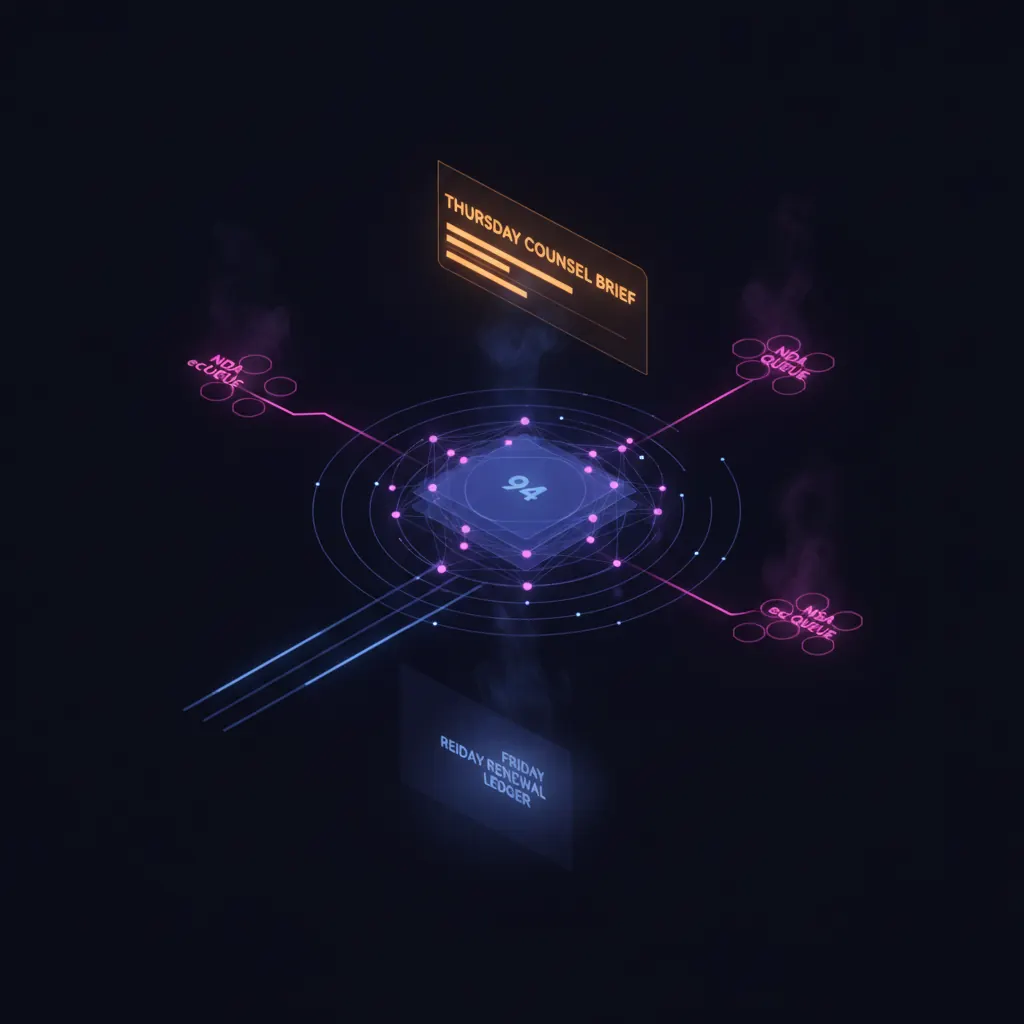
Thursday 8:00 AM. Counsel brief for the audit committee. Open exposure across the 240 contracts summarized against the risk tolerance, the six indemnity outliers with proposed remediation, the four regulatory filings due in the next 30 days with the owner and status cited, the three disputes in correspondence ranked by financial exposure.
Friday 8:00 AM. Renewal and close brief. The seven renewals closing the following week with the final counterparty position cited, the two negotiations that stalled past the 21-day median flagged for a GC call, the five contracts closed inside the week with the executed version linked to the system of record.
The unit economics on the function
A $280K GC reads $380K loaded. Two commercial counsel seats at $220K base read $300K to $340K loaded each, so $980K to $1.1M on the leadership legal line before an in-house hour touches the strategy work. 32 hours a week on contract hygiene across the three seats at a loaded hour of $140 to $220 costs the function $230K to $420K a year on queue work the system of record was supposed to run.
A 14-day sprint to stand up the Legal Ops agent runs in the low to mid five figures. Ongoing cost lands at $3K to $7K a month on API spend, read access to the contract repository and DocuSign queue, and the paralegal or ops operator who owns the Monday brief review. Year one lands at $55K to $130K against the $230K to $420K the function currently spends on senior legal time inside the queue. The GC and the commercial counsel seats stop running the shelf and land on the negotiations and the governance work the ledger was paying them to run on in the first place.
What the sprint ships in 14 days
Day one, the agent reads against the contract repository, DocuSign, the vendor-management system, the HRIS, and the Slack intake channel. Day seven, the first Monday exposure brief lands in the GC inbox with the 42 auto-renewals ranked and the 18 open redlines routed. Day fourteen, the Thursday counsel brief for the audit committee lands at 8:00 AM with the six indemnity outliers summarized and the four regulatory filings pre-cited.
If your contract shelf reads 240 live agreements, 42 of them auto-renewing inside 60 days, and last quarter already carried a $340K true-up nobody flagged, the version where the Monday brief lands at 8:09 AM is fourteen days away. The contract repository still stores the agreements. DocuSign still runs the signatures. The agent closes the function the stack was already supposed to close. You can keep running the renewal chase on a Thursday CSV export, or you can scope a sprint and have the Friday audit-committee pack landing before the next board read.
 2026-10-25
What a Fractional AI Hiring Ops Agent Does
A fractional AI Hiring Ops agent reads 240 candidates across 11 reqs, drafts the Monday scorecard brief, and ships offer-ready handoffs by 8:00 AM.
 2026-10-09
Your Recruiting Pipeline Has 240 Candidates and Six Moved Stage Last Week
Head of Talent opens Greenhouse Monday, 240 candidates in-pipeline across 11 reqs, six moved stage last week, 94 sitting past 21 days. A function nobody staffed.
 2026-10-05
Your Legal Queue Has 94 Contracts Open and GC Reviewed 11 This Month
Your GC opens the review folder Monday, 94 contracts open across vendor paper, NDAs, and renewals, 11 reviewed this month, 83 aging past 21 days. A queue nobody staffed.