Your SaaS Stack Has 142 Tools and IT Reviewed Six Renewals This Quarter
Head of IT opens Zip Monday, 142 SaaS contracts live, six renewals reviewed this quarter, 34 auto-renewed without a look. A function nobody staffed.

It is Monday, 9:12 AM. Your Head of IT opens Zip before the Monday finance sync. 142 SaaS contracts live. Six renewals reviewed this quarter. 34 auto-renewed since July 1 without a human reading the terms. The next 11 contracts auto-renew inside the opt-out window. The last negotiated save was 14 days ago, a $64K Datadog line pulled to $47K after the senior SRE pointed out the log-retention tier nobody turned on.
He opens the vendor master. 142 contracts across security, observability, data, sales, marketing, HR, and finance. 68 under $18K a year that nobody touches at renewal. 42 between $18K and $90K that one person opens the invoice for and one person approves. 22 above $90K that go through procurement if the FP&A lead flags them in time. 14 licenses sitting on Okta with zero logins in 90 days. Nine Slack channels for vendor onboarding, three of them archived. The Zip queue reads 11 open renewal reviews with the earliest opt-out in six days.
Pull the quarter. 34 contracts auto-renewed since July 1. Six formally reviewed by the IT and procurement pair. Four of the six landed a negotiated discount averaging 18 percent. The other 28 renewed at the price on the invoice, which carried a 7 to 11 percent uplift against last year on 22 of them. The CFO reads a $340K SaaS line that grew 24 percent year over year against 11 percent revenue growth. The CTO reads an observability bill up 42 percent against a product that shipped the same number of services.
SaaS renewal and vendor management is a function. Most Series B and C companies staffed it with a Head of IT who owns provisioning, a procurement lead who owns the contract library on a $14K to $34K Zip or Vendr seat, a finance partner who owns the budget line, and a department sponsor per vendor who owns the business case. The function lives in the gap between the Okta login log, the Zip contract metadata, the Netsuite GL line, and the quarterly departmental budget. On the org chart it reads IT or Procurement. In practice it reads a Monday Zip queue with 11 open reviews and 34 contracts already renewed.
The 34-auto-renewed math
Pull every renewal across the last six months. Log the vendor, the ARR impact, the renewal date, the opt-out window, the owner, the review status, the Okta seat count at renewal, the Okta seats active in the prior 90 days, the price uplift against last year, and the negotiated save. Count renewals where the Okta active-seat count was less than 60 percent of the licensed-seat count. Count renewals that landed inside two weeks of the opt-out and skipped procurement review. Count vendors where the department sponsor could not name the business case in a Monday Slack ping. Most Series B IT teams past 142 contracts find 22 to 34 percent of renewals auto-fire inside the opt-out window, 25 to 40 percent of licenses sit at under 60 percent utilization, and 15 to 25 percent carry a double-digit uplift the budget line never approved.
Walk one renewal. The Gong seat count stood at 94 at the Q2 renewal. Okta logged 42 active users in the prior 90 days. The AE roster at renewal was 48. The sales ops lead approved the renewal at 94 seats because reducing the count required a Zendesk ticket and a 20-minute Gong success-manager call. The Monday sales standup already ran long. The renewal fired with a $38K uplift against last year, a license count 46 above the active user floor, and no procurement review on file. The Gong contract clerked the ninth largest line item on the Q3 SaaS budget variance report. The CTO asked about it in Slack on day 19 after the budget variance landed.
The team that should own this knows it is broken. The Head of IT provisions 11 new seats a week and deprovisions four. The procurement lead opens the Zip queue on Monday and closes two reviews before the Thursday vendor call. The finance partner reads the SaaS line against budget on day 10 of close. The department sponsors sign the renewal in DocuSign the morning the auto-renew clock expires. The 34-auto-renewed backlog is the question nobody charged against a cadence outside the Monday Zip queue itself.
Why Zip and Vendr do not answer a question
You bought Zip or Ironclad or Vendr at $14K to $64K a year for the intake and the contract library. You bought Torii or Zylo at $18K to $42K a year for the SaaS discovery layer. You bought Okta at $24K to $94K a year for the identity log. You bought Netsuite at $34K to $140K a year for the GL. Zip stores the contract the procurement lead uploaded. Torii scrapes the SSO log and infers an active-seat count. Okta logs the login. Netsuite posts the invoice. None of them read Monday's 11 open renewal reviews, pull the Okta 90-day active-seat count against the licensed-seat count, score the vendor against the three cheaper substitutes and the two consolidation targets on the current stack, and route the four renewals ready for a decision to the Thursday vendor call.
Zip reports the Gong renewal sits in Awaiting Business Case. It does not know Okta logged 42 active users against 94 licenses. Torii reports the active-seat count. It does not score the current price against the market or the two internal substitutes that could absorb the use case. Okta logs the login. It does not read the Datadog log-retention tier against the ingest volume and tell the SRE lead the tier is wrong. Netsuite posts the invoice. It does not ask whether the invoice contradicts the opt-out letter the procurement lead filed in July. The intake tool is an intake tool. The SSO log is a log. Neither is a function.
What a fractional AI vendor function does
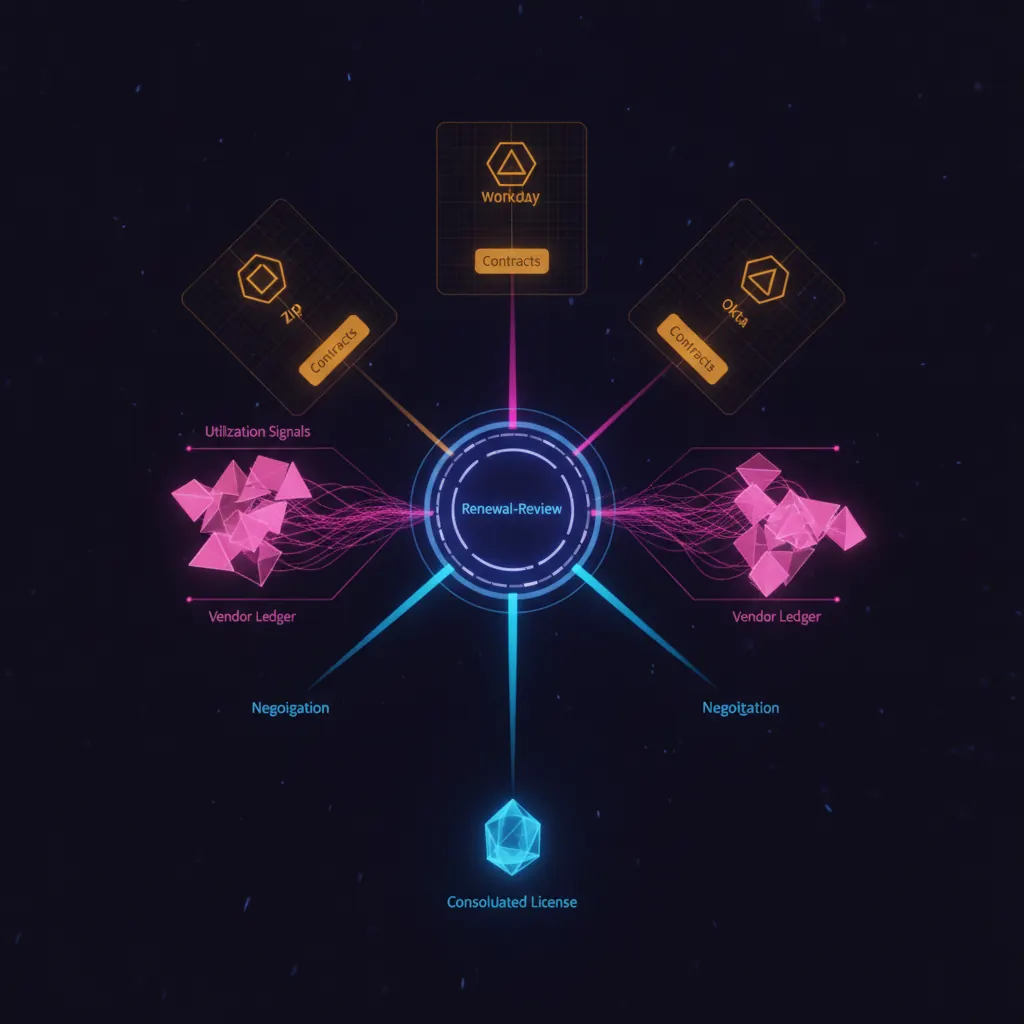
Hand the Zip contract library, the Torii or Zylo SaaS discovery export, the Okta identity log, the Netsuite GL, the DocuSign renewal archive, the department Slack channels, the procurement rate card, and the quarterly budget plan to a fractional AI agent. The agent does the work a procurement analyst, a FinOps analyst, and an IT-asset manager would do together. The cadence is per-contract on utilization scoring, per-week on the opt-out watchlist, per-renewal on the negotiation brief, per-quarter on the consolidation audit, and per-vendor on the price benchmark.
Every contract scored against utilization inside two hours of a quarterly Torii refresh. The Gong line scores on Tuesday at 11:04 AM. By 1:00 PM the agent has pulled the 94 licensed seats against the 42 active users on Okta, flagged the 52-seat gap, scored the current price against the public pricing page and the three deals the procurement lead closed on comparable observability and revenue-intelligence tools, drafted the ask to reduce seats to 54 and freeze the uplift, and queued the sales-ops Slack with the two scorecards attached. The procurement lead opens Wednesday with 11 pre-briefed renewals instead of 142 raw contracts.
Every opt-out date flagged with the next action pre-drafted. The 34 contracts inside the next 90-day opt-out window get clustered by business case on Monday morning. 14 are flagged for formal review with the Okta utilization gap named and the negotiation ask drafted. 11 are flagged for consolidation against two existing vendors the stack already pays. Six are flagged for cancellation with the deprovisioning plan drafted against the Okta groups. Three are flagged for seat reduction with the SKU the vendor rep accepted last year named. The Head of IT reads one list and clears 28 opt-out decisions in the Monday standup.
Every negotiation brief drafted off the vendor's own pricing history. The Datadog opt-out fires in 11 days. The agent reads the last three invoices, the ingest trend, the log-retention tier against query use, and the two renewal emails the sales rep sent. The brief lands in the procurement lead's Slack with the three asks ranked, the walkaway price named, and the two downgrade SKUs the rep accepted on last year's renewal cited. The procurement lead walks into the Thursday vendor call with the brief and clears the $17K save without a six-email thread.
Every new intake scored against the current stack before procurement opens the ticket. The marketing lead files a Zip intake for a new webinar platform. The agent reads the intake, pulls the three overlapping SKUs the stack already pays (Zoom, Hopin, Goldcast), scores the use case against the Zoom webinars SKU the stack already licenses, drafts the duplicate-tool flag, and routes a 10-minute call with the marketing lead to confirm the gap. Two intakes a month land in Zip with a duplicate_of flag that saves procurement the full RFP cycle.
The unit economics of a 142-contract stack
A Series B at $14M ARR running a 142-contract SaaS stack across one IT lead and one procurement lead is burning three lines. The Head of IT, the procurement lead, and the finance partner clear 24 to 42 hours a week on contract reads, utilization pulls, vendor calls, and Slack sign-off chasing against a loaded hour of $80 to $160. That is $14K to $28K a month of senior time on queue management the agent clears to a 10-minute procurement review. The team gets 11 to 18 hours a week back on the four strategic negotiations that compound the SaaS line.
The spend line is the second. Clearing the 34-auto-renewed backlog, pulling 25 to 40 percent of over-licensed seats, catching the double-digit uplifts the budget line never approved, and consolidating four to seven duplicate tools pulls 11 to 22 percent off the SaaS budget on a stack at $340K ARR. That is $37K to $75K a year on this size, and the save compounds into the next renewal cycle because the lower price becomes the new baseline. On a stack past $1M in annual SaaS spend the same ratios land in the six figures.
The budget-trust line is the third. The CFO reads a weekly SaaS digest that names the four renewals cleared under budget, the three uplifts the agent held flat, and the two consolidations shipped. The CEO reads the quarterly SaaS variance report and sees a line growing with revenue instead of twice as fast. The CTO reads the observability bill and gets to approve the next ingest tier against query use, not against a seat count the renewal clerked on autopilot.
A 14-day sprint to stand up the agent runs in the low to mid five figures. Ongoing cost lands at $3K to $7K a month on API spend, Zip and Okta and Netsuite read access, and tooling plus a fractional procurement operator at $4K to $8K a month who owns the Monday opt-out review and the quarterly consolidation audit. Utilization scoring and the opt-out watchlist ship in week one. Negotiation briefs and the intake duplicate-tool scoring ship in week two. The 34-auto-renewed backlog clears before the next quarterly review.
What changes after the sprint
Picture the same Monday, 9:12 AM moment, two months after the sprint ships. Your Head of IT opens Zip. 128 SaaS contracts live, 14 cancelled or consolidated during the sprint. 11 renewals reviewed this quarter against six last quarter. Zero contracts auto-renewed inside the opt-out window since the sprint shipped. The next 11 opt-outs read with the Okta utilization gap, the negotiation ask, and the walkaway price pre-drafted on each file.
By Thursday the procurement lead walks into the Datadog call with the three asks ranked and the two downgrade SKUs cited. The CFO reads a weekly SaaS digest that names the four renewals cleared under budget and the $42K of annualized save against the Q3 baseline. The department sponsors read a monthly scorecard that lists the vendors their team logs into and the three licenses the Okta log flagged as idle. The CTO reads an observability bill that tracks ingest volume instead of a seat count on a license nobody deprovisioned in April.
If your stack currently reads 142 contracts with six renewals reviewed this quarter and 34 auto-renewed since July 1, the version where every renewal scores inside two hours and every opt-out carries a pre-drafted negotiation brief is fourteen days away. SaaS renewal and vendor management is a function. You can hire a dedicated procurement lead, you can expand the fractional IT retainer, or you can scope a sprint and have it running before the next opt-out clock expires. The work is the same. The SaaS line is not.
 2026-10-08
Your Finance Close Takes 14 Business Days and Six People Live in the Workbook
CFO opens the close tracker on day one, 14 business days to a signed trial balance, six people in the master workbook, 42 reconciling items open. A function nobody staffed.
 2026-10-06
Your Data Team Has 94 Ad-Hoc Requests Open and Analysts Shipped Eleven This Sprint
VP Data opens the Jira queue Monday, 94 ad-hoc requests open across go-to-market, finance, and product, 11 shipped this sprint, 68 aging past 21 days. A queue nobody staffed.
- 2026-10-05
How SeoulClinics Leverages AI in Medical Tourism in 2026
SeoulClinics replaces the broker middleman with an AI directory that matches foreign patients to Korean clinics in two languages. Here is the operating shape.