Your Onboarding Takes 47 Days and Three Accounts Churned Before Go-Live
Your VP CS opens the onboarding tracker Monday, 47-day median to go-live, three accounts churned pre-value, $340K refunded. A queue nobody staffed.

It is Monday, 9:04 AM. Your VP Customer Success opens the onboarding tracker with the first coffee. The active tab lists 34 accounts inside the implementation window between contract countersign and go-live. Median time to go-live reads 47 days against the sales-deck promise of 21. Three accounts churned before first value in the trailing 90 days. The refund column reads $340K across the three, and the CFO countersigned two of the refunds without a save call.
She scrolls to the stage tab. Seven accounts sit in kickoff past day 14. Twelve sit in integration past day 21. Nine sit in training past day 30. Six sit in a stage the tracker still labels "in progress" with no owner assigned since the AE handed the account off in June. The Slack channel for the account that churned last Thursday has 214 messages, 8 owners across three teams, and one message from the buyer that reads "we hired a different vendor" on August 15th.
The founders in this seat keep opening an Implementation Manager req and wondering why net-new logos churn inside 90 days at a rate that turns the CAC-payback slide into a hostage negotiation. Onboarding is not a headcount. Onboarding is an eight-stage queue that starts the hour the DocuSign hits the inbox and ends when the customer runs the workflow the sales deck promised without pinging Slack. Four teams touch the queue and none of them own it end to end.
The 47-day path from countersign to first value
Sort the tracker by contract date. The median day-count sits at 47 with a long tail out to 94. Day one to day seven belongs to the AE-to-CSM handoff, which lands in a Notion doc with three fields filled and eleven left blank. Day seven to day eighteen belongs to the kickoff call, which slips twice on the customer's calendar because the CSM sent one confirmation and no reminder cadence. Day eighteen to day thirty-two belongs to integration, which stalls waiting on the customer's IT team to provision an OAuth app the docs page describes in a screenshot from a UI version that shipped in February.
Day thirty-two to day forty-seven belongs to training, which the CSM runs live on Zoom against a slide deck last edited by a PMM who left in April. The customer's admin attends session one, sends a delegate to session two, and no-shows session three. Go-live lands on day forty-seven if the customer's admin still has the account. Three of the trailing 90-day cohort lost the admin to a job change between day thirty and day sixty, and the replacement admin restarted the training track from day one on a fresh calendar.
The AE who signed the deal does not own the handoff document. The CSM who owns the handoff does not own the integration checklist. The solutions engineer who owns the integration does not own the training track. The support engineer who works the go-live tickets does not own the health score. Four teams, one queue, zero owners on the queue itself. The Q4 renewal book inherits the accounts that survived, and the health score on those accounts already reads yellow on day one of the renewal window.
Stage one: the handoff brief nobody writes from the closed-won record
The Series B version of this function ships a written handoff brief inside four hours of the countersign. Reads the Gong transcripts from the last five sales calls. Reads the security questionnaire the buyer completed. Reads the RFP response the SE drafted. Reads the CRM stage-history and the two competitor names that came up on the demo. Drops a two-page brief into the CSM's inbox with the buyer's stated success criteria, the three integration dependencies the SE flagged, the exec sponsor's title and last-touch date, and the one landmine the AE noticed on the pricing call.
The version most Series B teams run: the AE marks the opp closed-won, drops a two-line message in the CS Slack channel, and moves to the next quota-carrying week. The CSM opens the account Monday, reads the last two email threads, and books a kickoff call on the customer's calendar without a written agenda. The kickoff call spends 40 of its 60 minutes rediscovering context the AE already captured in Gong, and the customer's admin leaves the call less confident than she was on the demo. The follow-up email lands 72 hours later with three action items pointed at the wrong owner on the buyer side.
The stage-one function joins the CRM, Gong, the RFP response, the security questionnaire, and the pricing quote into a single brief. Lands on day zero. The CSM walks into the kickoff on day three with the buyer's own words on the page, and the kickoff-to-integration transition collapses from 18 days to 6. The buyer's admin walks out with a shared success plan she read before the call, not one drafted from memory an hour after.
Stage two: the integration checklist that lives in three tools
The integration runbook lives in a Notion page last edited in May. The API docs live on the developer portal last regenerated in June. The OAuth setup lives in a Loom video the SE recorded in March against a UI that shipped a redesign in July. The customer's IT lead opens all three, finds three different screenshots of the same screen, files a support ticket asking which one is current, and the ticket sits four days in a queue that nobody triages for onboarding accounts.
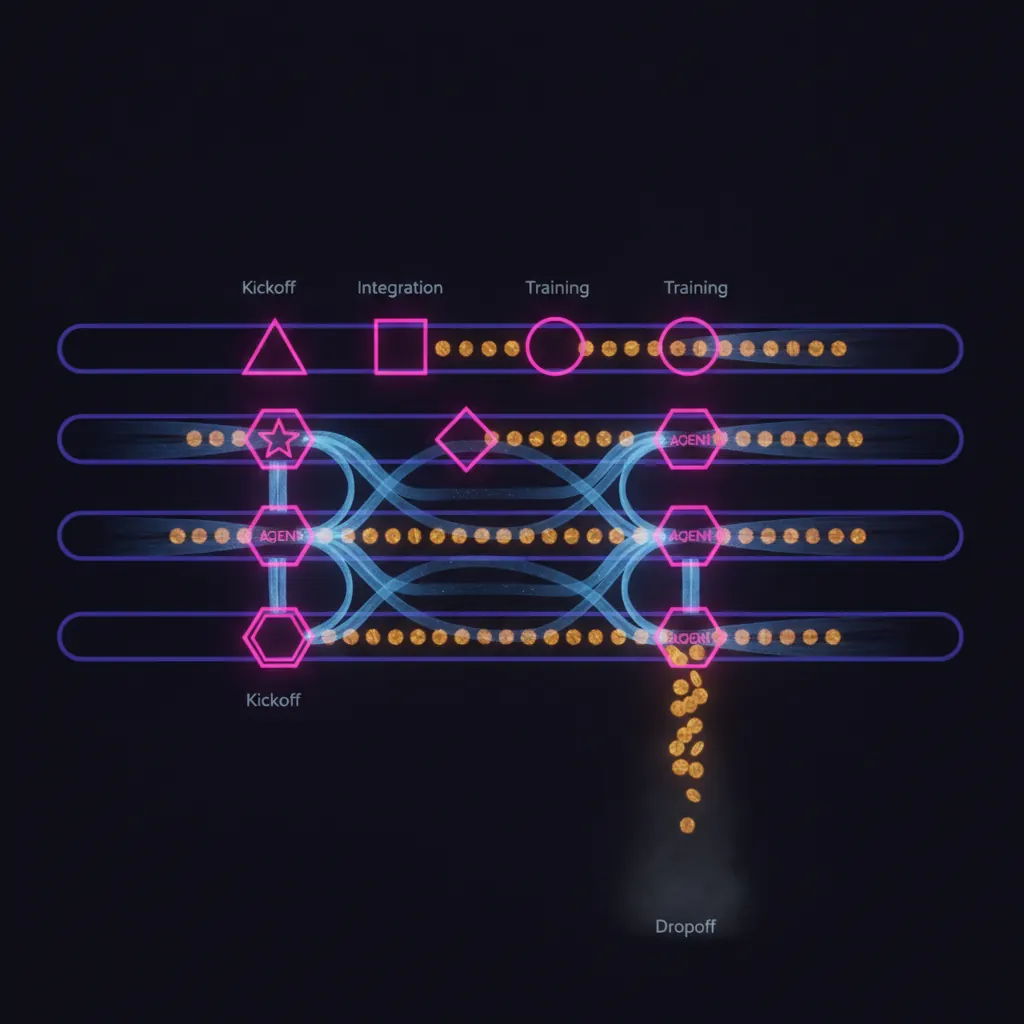
The stage-two function reads every UI shipment against the runbook, the docs page, and the Loom library on a nightly cadence. Flags every screenshot older than the last UI release. Regenerates the OAuth walkthrough from the current build. Drafts the account-specific integration checklist inside two hours of the kickoff call, pre-populated with the buyer's stack from the security questionnaire, the three data sources the buyer named, and the two IAM constraints the SE flagged. The customer's IT lead reads a checklist that matches the screen in front of them, and the integration median collapses from 14 days to 5.
Stage three: the training track only two customers ever finish
The 34 active accounts include 22 with an assigned training track. Of the 22, two customers completed all four sessions. Twelve completed two of four. Eight completed one. The completion rate the tracker reports as 34 percent is 9 percent when weighted by sessions attended. The CSM re-runs session one live on Zoom every week for a different customer because the recording library has three versions of the same session and none of them match the current UI.
The Series B version of this function ships an in-product training track built from the customer's actual configuration on day one. Reads the workflows the buyer named on the demo. Reads the integrations the SE provisioned on day five. Reads the seat list HR uploaded on day eight. Assembles a role-specific walkthrough for admins, power users, and viewers against the buyer's own data. The training completion rate on the trailing cohort runs 71 percent by session, the CSM stops re-running session one on Zoom, and the go-live date lands on day 22 instead of day 47.
The math against the next Implementation Manager hire
Run the two paths against the Implementation Manager req sitting in the drafts folder at $128K base plus 15 percent variable. Path A closes the req in October, ramps the hire through Q1, and adds a fifth IM to a team covering 34 active accounts at any given time. Loaded year-one cost lands $184K to $224K, ramps to first solo go-live in month three, and the 47-day median moves to 41. Same queue, one more headcount, same three churns in the trailing 90-day cohort because the queue behind each account did not change.
Path B ships a three-sprint fractional AI onboarding function at $84K to $120K in build across the first 60 days and $6K to $9K a month to run. Sprint one lands the handoff brief on every countersign. Sprint two lands the integration checklist and the docs-freshness scan. Sprint three lands the in-product training track built from the buyer's own configuration. The 47-day median collapses to 22, the trailing 90-day cohort ships zero churns, and the $340K refund line that hit Q3 does not repeat in Q4. The 14-day sprints that ship this function cost less than the fully loaded search retainer for the Implementation Manager.
The four numbers a VP CS runs before the next Implementation Manager req
The founders reading this are two weeks from posting an Implementation Manager req on the strength of the "coverage ratio" narrative. Before the offer letter goes out, run four numbers against the onboarding function, not the headcount. Score the queue, not the hire. The queue owns the number the board reads.
Median time to first value. Measure days from contract countersign to the first customer-run workflow the sales deck promised. A healthy function runs 14 to 21 days. A stuck function runs 40 to 60 days, and the CAC-payback slide moves the wrong direction every board meeting.
Handoff-brief coverage. Divide the count of countersigns with a written handoff brief in the CSM's inbox inside 24 hours by the total count of countersigns in the trailing 90 days. A healthy function runs 95 percent plus. A stuck function runs 12 to 25 percent, and the kickoff call rediscovers context Gong already captured.
Docs freshness age. Measure the median days between the last UI release and the last edit to the runbook, developer portal, and Loom library. A healthy function runs under 14 days behind the release. A stuck function runs 60 to 120 days behind, and the customer's IT lead files a ticket asking which screenshot is current.
Pre-value churn count. Count the accounts that churned before the first customer-run workflow in the trailing 90 days. A healthy function ships zero. A stuck function ships two to four, and the CFO countersigns the refund without a save call. Any two numbers in the stuck zone means the queue is the problem, not the headcount, and you can scope the onboarding function in a 30-minute call this week.
- 2026-10-05
How ShakeGasm Leverages AI in Party Game Design in 2026
ShakeGasm uses AI as a game-design co-pilot, generating ruleset variants for phone-sensor party games. Here is how consumer-fun apps use AI differently.
 2026-10-02
Your Customer Onboarding Takes 94 Days and 27% Churn Before Second Invoice
VP CS opens implementation tracker, 34 accounts, oldest 148 days post-kickoff, 27% churn before second invoice. Onboarding is a function you never staffed.
 2026-09-11
Your Onboarding Queue Has 22 New Logos and Implementation Started on Six
Your VP CS opens the onboarding tracker Monday, 22 new logos closed in Q3, six kickoffs on the calendar, four sitting past day 21. A queue nobody staffed.