Your Copilots Are Not Employees and Your Org Chart Still Has the Same Gaps
Your team pays for 14 copilot seats and every function on the org chart still ships late. Copilots accelerate a hire. They do not replace one.

It is Monday, August 10th, 9:04 AM. Your VP People opens the SaaS ledger and counts 14 copilot seats live across the company. Github Copilot on 34 engineering seats. Salesforce Einstein on 22 rep seats. HubSpot Breeze on 18 marketer seats.
Notion AI on 140 workspace seats. Gong AI on 34 seats. Zendesk AI on 18 support seats. Total copilot spend for July: $38,400.
She opens the same board deck the CFO opened Friday. The Q3 goals name a case-study backlog of 44 stories, an RFP queue that missed a deadline in July, a support queue at 340 tickets past SLA, a hiring pipeline sitting on 47 uncontacted applicants, and a competitive intel folder last touched in April. Every function on that list already has a copilot seat inside it. Not one function on that list ships on time.
Pull the July timesheet against the July output. Engineering shipped faster per PR. Sales reps closed the same number of deals per rep. Marketers drafted more Notion pages per week. Support agents resolved tickets quicker per ticket.
The AE team's win rate did not move. The case-study backlog did not shrink. The RFP queue did not clear. The competitive cards did not refresh. The support queue did not drain. The hiring pipeline stayed silent.
The tools accelerated the person at the seat. The seat was never the bottleneck. Copilot spend hit $38K in July on 266 seats. Function-level output on the same list of stuck queues moved zero. The board deck flags AI adoption as a Q3 win. The board deck does not flag that AI adoption inside individual workflows does not staff a function nobody owns.
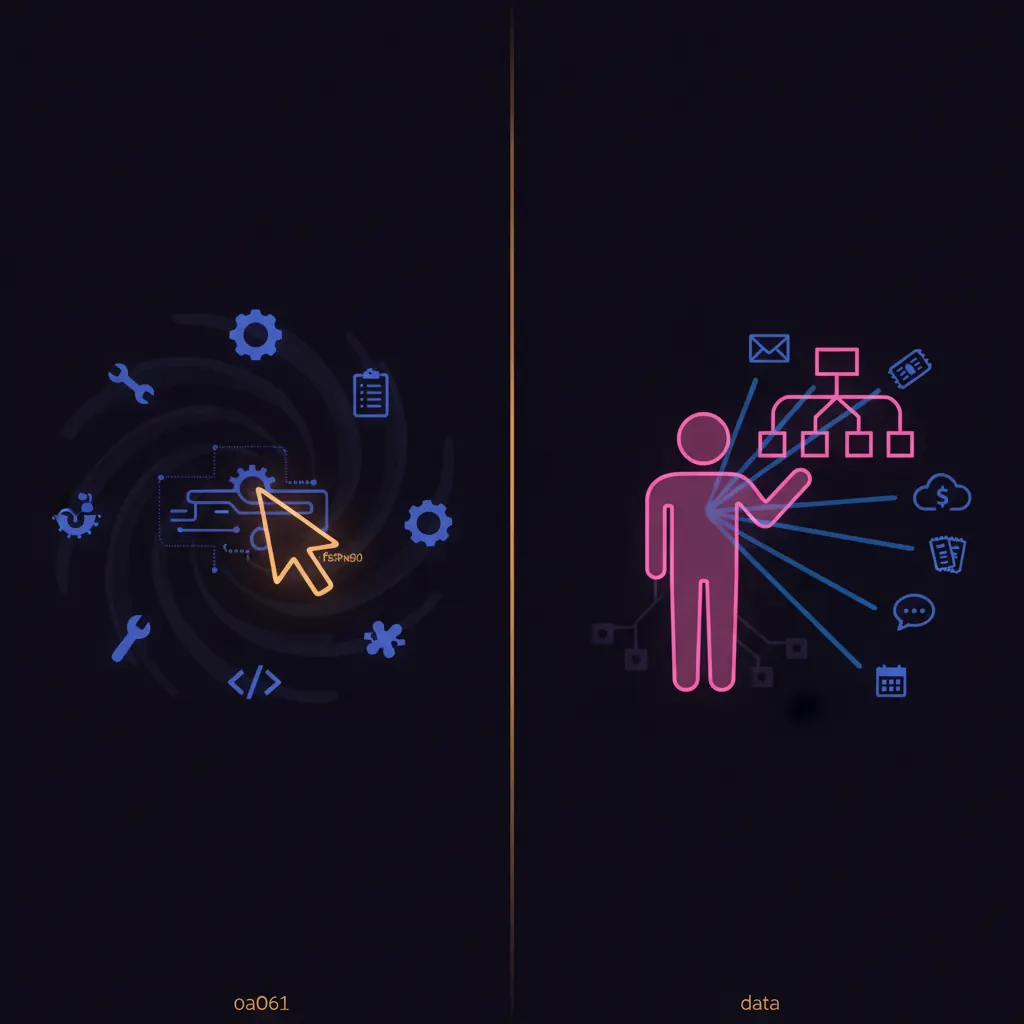
A copilot lives inside a seat, a function lives across seats
A copilot is a productivity accelerator bolted to one workflow inside one tool. Github Copilot writes the next line inside VS Code while a paid engineer types. Salesforce Einstein drafts the next sentence inside an AE's email while the AE sits at the keyboard. Notion AI writes the next paragraph inside a page while the writer holds the cursor. Gong AI summarizes the call the rep took. Zendesk AI drafts the reply the agent is about to send. Every one of those tools sits inside a seat, waits for a human to open it, and speeds up the ten seconds after the human clicks.
A function does not live at a seat. Case-study production lives across a Notion pipeline, a Salesforce closed-won object, a Gong library, an NPS feed, a G2 inbox, a Slack channel, a Figma template, and a WordPress category page. Competitive intel lives across four competitor changelogs, a Klue trial that expired, a Gong objection library, a Reddit feed, a G2 review stream, and eight battle cards in Notion. RFP response lives across a security portal, a redlined Google Doc, a subprocessor list, three shared drives, and a legal thread with the customer. The function does the work that happens when nobody is at a seat.
The tools sit inside seven different vendors, each with its own copilot bolted on. None of the copilots read the other six systems. None of them own an outcome. None of them ping a human on Sunday night when a competitor ships a public changelog. None of them draft a case-study outreach at 3:20 PM the same day the CSM Slacked the customer's expansion note. The seat holder still has to open the tool, remember to run the copilot, review the output, and route it downstream. When the seat holder logs off, the function stops.
The seven functions your copilot spend does not staff
Case-study production. Github Copilot does not draft your fintech expansion story. Notion AI does not pull the outcome number from the Gong transcript, match it to the closed-won note, send the interview ask with three Calendly slots, route the draft through legal, and push the published asset to the sales deck, the paid landing page, and the SDR sequence library. Case-study production is a function. Notion AI is a text completion tool inside a page. Your 47 nominations still show 3 published stories.
Competitive intelligence. Salesforce Einstein does not watch the primary competitor's changelog at 9:14 AM on a Wednesday. Gong AI does not cluster the July 30th BI objection into a taxonomy of 14 mentions across nine accounts. Klue expired in February. Competitive intel is a function. Einstein is a next-sentence completion tool inside an AE's inbox. Your battle cards still say version 2.1 while the competitor shipped 4.3 in June.
RFP and security response. HubSpot Breeze does not open the 214-question security questionnaire, match every answer against your SOC 2 evidence library, redline the two clauses your GC always changes, and ship the response inside 72 hours instead of 34 days. Zendesk AI does not either. RFP response is a function. Breeze is a marketing email drafter. Your $410K deal still slipped in July.
Support triage. Zendesk AI drafts a reply inside the ticket the agent already opened. It does not read the 340 open tickets in the queue at 6 AM, cluster them by root cause, route the top 41 percent to the right agent with a pre-drafted response, escalate the $180K account on day 11, and post the 8 AM triage board in the CX Slack. Support triage is a function. Zendesk AI is a reply drafter inside an already-opened ticket.
Inbound speed to lead. Nobody's copilot dials the inbound demo request at 11:42 PM on a Saturday. Salesforce Einstein does not book the call, enrich the account, brief the AE, and hand off before Monday morning. The 34 inbound requests still sit 27 hours before anyone calls. Speed to lead is a function. Einstein is not.
Deal-desk approvals. No copilot enforces the 20 percent discount threshold when the VP approves $180K from Slack in an Uber. No copilot logs the CPQ trail, drops the CFO memo, notifies finance, and files the audit note the same day. Deal desk is a function. The copilots on the ten adjacent seats are not.
Vendor rationalization. No copilot in your stack reads the 214 SaaS invoices, matches every license to a login trail, files the 88 zero-login tools into a cancel queue, drafts the vendor emails, and books the savings on the CFO's dashboard the same week. Vendor management is a function. Every vendor's copilot is a tool inside its own product, selling more seats of itself.
What a copilot cannot do that an employee can
An employee owns the queue. A copilot waits for the seat holder to open the queue. The queue drifts on holidays, on the marketing coordinator's exit interview week, on the CSM's PTO, on the AE's flight day. The copilot does not notice. The employee opens the queue Monday and clears the drift.
An employee holds a cross-system read. A copilot reads one system. Case-study production needs Notion, Salesforce, Gong, NPS, G2, Slack, Figma, and WordPress on one desk. No copilot in that stack reads the other seven. The employee opens seven tabs. The copilot sits inside one.
An employee sends the outreach. A copilot drafts what the seat holder is about to send when the seat holder opens the tool. The customer marketing coordinator sends the interview ask on Tuesday morning after the CSM Slacked her Monday afternoon. Notion AI drafts the ask if the coordinator opens a page and types the prompt. If the coordinator never opens the page, the ask does not go out.
An employee holds an SLA. A copilot has no SLA. Zendesk AI drafts the reply if the agent opens the ticket inside the SLA. If the ticket sits 12 hours before anyone opens it, the SLA breach already happened. The employee opens the queue at 8 AM Monday and clears the SLA breach in the morning.
The unit economics of $38K a month on copilots that do not staff a function
A Series B company at $22M ARR spending $38,400 a month on 266 copilot seats is buying seat-level acceleration. On engineering, that maps to a measurable 8 to 18 percent PR throughput lift on 34 engineers. On sales email, that maps to a 12 to 22 percent drafting time cut on 22 reps. On marketing, that maps to a 20 to 34 percent Notion-page drafting speedup on 18 marketers. Every one of those lifts is real and every one lands inside an existing seat.
The function work on the same board deck stayed stuck. The case-study backlog cost the demand gen team 4 to 8 published stories a quarter, translating to 12 to 24 points of MQL-to-SQL drop on the paid landing pages and a 30 to 60 percent lift missed on outbound reply rates. The competitive drift cost the AE team 6 to 12 points of win rate against the top competitor, mapping to $1.4M to $4.5M of ARR defended a year on 34 competitive deals at a $180K to $310K average. The 34-day security questionnaire queue slipped one $410K deal in July. The support queue at 340 open tickets with 41 percent past SLA drives 2 to 4 points of gross churn a quarter on the mid-market book.
Copilot spend at $38K a month is $460K a year. Function drift on those same seven areas is somewhere between $3M and $8M of ARR left on the floor. The tools accelerated the hire. The functions still went unstaffed. Buying more copilot seats does not close a function gap. It makes the existing seat holder slightly faster at a queue nobody owns end to end.
A fractional AI agent is an employee-shaped unit that owns one function full time. Not a seat. Not a workflow. A whole function. It reads every system the function touches, holds the queue, sends the outreach, drafts the asset, routes the review, publishes the output, and pings a human on the exceptions.
A 14-day sprint stands one up in the low to mid five figures. Ongoing cost runs closer to a mid-tier SaaS seat than a full loaded hire. The math on one function typically pays back inside a quarter on ARR defended or ARR recovered. The case-study version walks the same math with real queue counts.
What changes when a function has an owner
Picture the same Monday 9:04 AM moment, sixty days after the sprint ships on two functions. Your VP People opens the SaaS ledger. Copilot spend is flat at $38K. Two fractional AI agents are running under $12K a month combined. The case-study pipeline shows 34 rows past outreach status, 14 stories published in the last 30 days, 6 in legal review this week. The battle-card workspace shows seven of eight cards refreshed inside the last 14 days, an AE morning brief posted at 7:58 AM every weekday, and win rate against the top competitor up 8 points on the last 30 days of closed opportunities.
The engineering copilot still speeds up the next PR. The AE copilot still drafts the next email. The marketing copilot still writes the next Notion paragraph. The seat-level acceleration keeps working. On top of it, two functions on the board deck now have an owner that reads every system, holds every queue, and ships every asset without waiting for a seat holder to open the tool.
Copilots are the assistant next to the seat. They are worth every dollar for the seat holder. They do not staff a function. If your board deck names seven stuck queues and your SaaS ledger names 14 live copilot seats, the version where two of those queues have an employee-shaped agent running end to end is fourteen days away. Copilots accelerate a hire. A fractional AI department is the hire. You can scope a sprint this week.
 2026-09-15
Your AI Copilot Is Not an Employee. It Waits for a Prompt.
You bought 340 Copilot seats at $30 a month. Nobody ran a function. A copilot waits inside an app for a prompt. An employee runs a cadence.
 2026-08-11
How to Scope a 14-Day AI Sprint Before You Sign the Check
Founders keep asking what fits inside a 14-day AI sprint. The answer is one function, one queue, three data sources, one live output the team already reads.
 2026-05-31
Your Copilot Is Not An Employee
Your engineers have Copilot, your PMs have ChatGPT, your CEO has Claude. You have an AI tooling budget. You do not have an AI strategy.