Your Case Study Pipeline Has 47 Happy Customers and 3 Published Stories
Your CMO opens the case-study tracker Friday, 47 happy accounts flagged since January, 3 published stories live on the site, 34 quotes rotting in Gong.

It is Friday, August 8th, 2:14 PM. Your CMO opens a Notion database named Case_Study_Pipeline_2026. 47 rows. She sorts by "customer nominated date". The top row is a fintech account CS flagged January 12th after an 8x ARR expansion, no story written. The next is a logistics account the AE nominated in February after a public LinkedIn shout-out from their COO, no story written. The third is a healthtech account that hit 340 percent net revenue retention in Q1, no story written. She scrolls down. Three rows have the "published" tag. The last publish date on the marketing site is March 4th.
She opens Salesforce. Of the 47 nominated accounts, 34 are still active, 6 have expanded again in the last 90 days, 3 have churned since the nomination, 4 are in renewal negotiations this quarter. The board deck names case studies as a Q3 pipeline lever. The board deck does not name that the last case study interview call sat in the marketing coordinator's queue for 62 days before she left the company in June.
Pull every closed-won note from the last four quarters. 214 wins, 47 tagged by CS or AEs as "case study candidate", 3 shipped to the site, 44 that never made it past the intake row. Cross-check the win notes and 88 percent name a hard outcome the customer volunteered on a call: hours saved, dollars recovered, ramp cut in half, DSO down 22 days. The Gong library has 340 clips tagged "customer quote" nobody clustered. The demand gen team is buying LinkedIn ads for a landing page whose three case studies were written for pain points the product has since deprecated.
Case study production is a function. Most Series B and C teams past $15M ARR have not staffed it because the founder used to write the first three case studies over a weekend after the first ten reference customers. The count grew to 47 nominations a year, a Notion pipeline nobody grooms, a G2 review feed with 214 quotes a quarter, a Gong library with 3,400 calls, an NPS survey generating 34 promoter responses a month, a #customer-love Slack channel with 214 screenshots a quarter, a Figma template last touched by the last content designer in May, and a WordPress category page nobody updates. The function lives in the gap between the CMO who owns the site, the head of CS who owns the relationship, the demand gen lead who wants the sales enablement asset, the product marketing lead who wants the segment story, and the AEs who need the logo slide. On the org chart it sits under marketing. In practice it sits inside a Notion database nobody opens between planning cycles.
The 44-story gap math
Pull every case-study nomination logged the last twelve months. Log nomination source, nominated date, first interview date, first draft date, publish date, customer segment, ARR band, outcome metric, and the AE or CSM who nominated. Cross-check against closed-won note text, Gong call transcripts, NPS survey verbatims, and public LinkedIn posts from customer contacts. Most teams past Series B find case-study conversion under 10 percent nomination to publish, median time from nomination to publish over 180 days, 60 to 80 percent of nominated accounts with a hard outcome metric already sitting in a Gong quote or NPS verbatim, and one in three nominated accounts expanding again before anyone opens the interview call.
Walk one nomination. The fintech account expanded 8x January 12th. The CSM Slacked the marketing coordinator the same day with the account name and the outcome number. The coordinator added the row to the Notion pipeline January 14th, tagged the segment, and queued an outreach email for the following Monday. The Monday hit a webinar launch. She returned February 3rd, sent the ask to the customer's VP Ops. The VP replied February 10th agreeing to a 30-minute interview the week of February 24th. The interview slipped twice for the customer's board prep. It landed March 12th. The coordinator transcribed the call, drafted a 900-word story, sent it for the customer's legal review April 4th. Legal came back with edits April 28th. The coordinator left the company May 14th. The draft sits in a Google Doc nobody has opened since.
The team that should own this knows it is broken. The CMO wants three fresh case studies a quarter for the sales team and the site. The head of CS forwards happy-customer emails to marketing every other Friday. The AEs paste customer quotes into #customer-love and get thumbs-up reactions. The demand gen lead runs paid ads against a category page with three stories written for last year's ICP. The product marketing lead flags the segment gap on the quarterly planning call. No single owner ingests every nomination the week it lands, matches the account against Gong quotes and NPS verbatims for a pre-drafted outcome narrative, sends the customer outreach inside 48 hours, drafts the story inside a week of the interview, and pushes the final asset to the site, the sales deck, the paid landing page, and the SDR sequence library the same week it publishes.
Hiring a customer marketing manager is the slow answer
The textbook fix is a senior customer marketing manager or a director of content. Loaded comp in the US runs $140K to $210K a year. Months one through three go to auditing the Notion pipeline, standing up the interview cadence, and rebuilding the segment story taxonomy. Months four through nine are when case-study conversion rises from under 10 percent to 40 to 60 percent, median time from nomination to publish drops from 180 days to under 30, and the sales deck gets a fresh logo slide with a matching one-page PDF every month.
The fractional version is faster and stops at the same wall. Five to eight thousand a month buys ten to fifteen hours a week of senior customer marketing work. The first month rebuilds the pipeline and ships two backlog stories. The 47-nomination annual load keeps drifting because a fractional lead cannot ingest every nomination the day it lands, cluster every Gong quote and NPS verbatim against the account list weekly, draft a pre-interview outcome narrative from the closed-won note before the customer picks up the phone, publish the story to the site, the sales deck, the paid landing page, and the SDR sequence library inside a week of legal sign-off, and retire the three stories that were written for a deprecated ICP.
Both versions assume the work is a person writing stories on a cadence. The work itself is watching every closed-won note, every CSM nomination in Slack, every NPS promoter response, every G2 review over four stars, every LinkedIn mention of the product by a customer contact, and every #customer-love screenshot, clustering the signals by account and pulling the outcome metric from the Gong transcript on the same day, drafting a 200-word outcome brief before the customer outreach goes out, sending the interview ask inside 48 hours of nomination with three time slots pre-booked against the AE's calendar, drafting the 900-word story inside 48 hours of the interview, routing the draft through legal with a 5-day clock, and pushing the published asset to five downstream destinations the same week. On 47 nominations a year plus 214 quarterly quote signals that is 28 to 38 hours a week of senior content work. No single hire clears that pile and holds a 30-day nomination-to-publish bar at the same time.
What a fractional AI customer marketing function does
Hand the Notion pipeline, the Salesforce closed-won object, the Gong library, the NPS survey feed, the G2 review inbox, the #customer-love Slack channel, the case-study Figma template, and the WordPress or Sanity CMS to a fractional AI agent. The agent does the work a customer marketing manager, a content designer, and a demand gen coordinator would do together. The cadence is per-nomination on ingestion, per-week on the quote cluster, per-story on legal routing, and per-publish on the five-destination push.
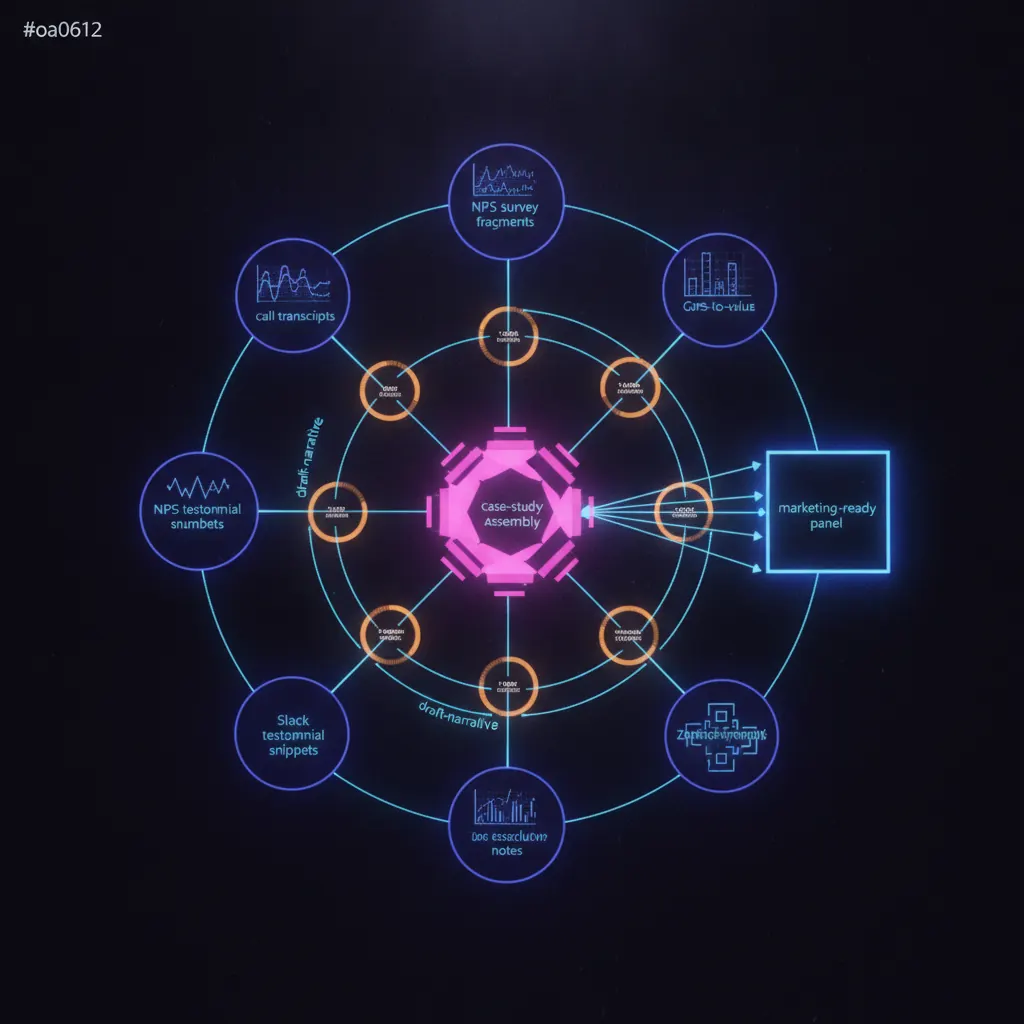
Every nomination ingested inside 24 hours. The CSM Slacks the coordinator with a fintech expansion note at 11:42 AM. By 3:20 PM the agent has parsed the note, pulled the closed-won and expansion notes from Salesforce, clustered the last 14 Gong calls with the account for outcome quotes, matched three NPS verbatims from the customer's VP Ops, drafted a 200-word outcome brief, and posted it in the CMO's Slack for a 10-minute review before the outreach email goes out.
Every customer outreach sent inside 48 hours with three time slots. The interview ask goes to the customer's VP Ops with a 30-minute Calendly link, three pre-cleared time slots against the AE's calendar, the outcome brief attached so the customer can confirm the numbers before the call, and a two-line legal summary so the customer's comms team can green-light the ask on the same thread.
Every interview transcribed and drafted inside 48 hours. The 30-minute call closes at 11:00 AM on a Tuesday. By Thursday morning the agent has transcribed the call, cross-referenced the outcome numbers against Salesforce and the closed-won note, drafted a 900-word story in house voice, pulled three pull-quotes, and posted the draft in the CMO's Slack for a 25-minute review instead of a week of coordinator drafting.
Every legal review routed with a 5-day clock. The draft goes to the customer's legal contact with a redline-friendly PDF, a two-line summary of the claims requiring sign-off, and a 5-day reply clock. At day 3 with no reply the agent re-pings with the AE and CSM on the thread. Cleared drafts route to internal legal for a subprocessor and trademark pass on a same-day SLA.
Every published story pushed to five destinations the same week. The site page publishes on WordPress or Sanity. The one-page PDF drops into the sales deck folder. The logo slide updates in the master deck. The paid landing page refreshes with the new proof point. The SDR sequence library gets a new outbound snippet with the outcome metric and a quote. The demand gen lead gets a Slack ping with the new asset URLs and the three segments the story maps to.
The unit economics of 47 nominations a year
A Series B company at $22M ARR with 47 nominations a year and an average deal size of $80K to $180K in the segment is burning three specific things. The CMO, the head of CS, the marketing coordinator, the demand gen lead, and the AEs spend a combined 6 to 10 hours per nomination on outreach chasing, interview coordination, drafting, legal ping-pong, and asset publishing against a fully loaded hour of $140 to $260. That is $840 to $2,600 a nomination on work a live agent clears in a 25-minute review. Across 47 nominations that is $40K to $122K of senior time a year the site never sees.
The pipeline lift line is the second one. Cutting nomination-to-publish from 180 days to under 30 and pushing every published story into the sales deck, the paid landing page, and the SDR sequence library the same week pulls 4 to 8 fresh proof points into the demand gen rotation a quarter. On outbound sequences, case-study proof lifts reply rates 30 to 60 percent in the segment. On paid landing pages, matched-segment case studies lift MQL-to-SQL conversion 12 to 24 points. The inbound demo queue starts converting on a live proof point instead of a generic value prop.
The customer marketing line is the third. Nominated customers who never get the interview call notice. Six to ten of the 47 nominated accounts a year quietly downgrade their reference willingness inside 12 months of a silent nomination. Closing the loop inside 48 hours and shipping the story inside 30 days keeps the reference pool warm and buys the CSM team a fresh talking point for the next QBR.
A 14-day sprint to stand up the agent runs in the low to mid five figures. Ongoing cost lands closer to a Contentful seat than a customer marketing hire. Nomination ingestion, Gong and NPS clustering, and the outcome-brief workflow run in week one. Interview routing, drafting, legal routing, and the five-destination publish push run in week two. The first agent-drafted story lands in the CMO's Slack inside a week of the next nomination.
What changes after the sprint
Picture the same Friday, 2:14 PM moment, forty-five days after the sprint ships. Your CMO opens the case-study pipeline. 47 rows, 34 with a status past "outreach", 14 published in the last 30 days, 6 in legal review this week, 3 shipping Monday. She opens the fintech story. The 8x expansion number pulled from the January closed-won note. Three pull quotes from the VP Ops interview. A one-page PDF in the sales deck folder. A refreshed logo slide in the master deck. A paid landing page live with the new proof point. An SDR sequence snippet in Outreach the SDR team started firing Tuesday.
By Monday the demand gen lead ships a paid campaign against the healthtech segment with three fresh stories. The AE team walks into the Q3 pipeline call with a logo slide that matches the accounts they are pitching this quarter. The head of CS forwards a Friday happy-customer email at 11:00 AM. The nomination lands in the CMO's Slack as an outcome brief by 2:20 PM.
If your case-study pipeline currently shows 47 nominations and 3 published stories written for a deprecated ICP, the version where every nomination gets an outcome brief inside a day and a published asset in the sales deck inside a month is fourteen days away. Case study production is a function. You can hire against it, you can retain a fractional customer marketer for it, or you can scope a sprint and have it running this month. The work is the same. The math is not.
 2026-09-08
Your Content Team Shipped 14 Posts in Q3 and Organic Traffic Flatlined in June
Your Head of Marketing opens GSC Wednesday, 14 posts shipped in Q3, 340 target keywords tracked, organic sessions flat since June 8. A queue nobody staffed.
 2026-08-29
Your Competitive Intel Deck Lists Four Competitors and Sales Cites Two on Calls
Your CMO opens the CI deck Wednesday, four competitors listed, two named on sales calls, last update in March. A queue nobody staffed end to end.
 2026-08-24
Your PMM Shipped Four Launches in Q3 and Sales Mentions Two on Calls
Your Head of PMM opens the launch tracker Friday, four features shipped in Q3, two on the sales talk track, one in the demo. A queue nobody staffed.