Your Customer Onboarding Stalled at Day 47
Your CS ops lead opens the tracker Wednesday, 12 accounts past day 30, one $180K deal at day 91. Onboarding is a function you never staffed.

It is Wednesday, 3:47 PM. Your CS ops lead pulls the implementation tracker for the weekly kickoff meeting. 34 active onboarding accounts. 18 sit within the 30-day target window. 12 sit past day 30. Four sit past day 60. One $180K enterprise sits at day 91 and has logged in twice.
She opens the day-91 account. The kickoff call happened on the 12th of April. The technical scope doc arrived from the buyer on the 24th. Nobody on your side responded until May 3rd. The implementation lead who owned it moved to a different account in May. The new lead inherited seven other accounts the same week. The Slack channel #impl-acme reads a thread of eight messages, the last one from your side dated May 22nd asking for a status update.
She opens the day-63 account. The buyer submitted a support ticket on day 41 asking why the SSO integration was still pending. The ticket routed to Tier 1 support. Tier 1 marked it "product question" and sent a link to the docs. The buyer never replied. The AE has emailed the CS lead twice asking whether the account is going to close-lost the renewal in October.
Customer onboarding is a function. Most Series B and C teams have not staffed it because the implementation manual was written when the company had six customers, the AE hands the deal to a CSM the day it closes, and the CSM assumes the buyer will drive the timeline. The function lives in the gap between the AE who moves to the next quota, the CSM who books a kickoff and waits, the implementation engineer who solves the ticket that got escalated but not the one that did not, the support queue that treats onboarding blockers as generic questions, the buyer who quietly loses momentum, and the CFO who watches time-to-first-value drift from 22 days to 47. On the org chart it sits inside Customer Success. In practice nobody owns the day-by-day.
The 12 accounts nobody is driving
Pull every account that signed in the last 120 days. The CRM close-won records, the implementation tracker, the shared drive folder for scope docs, the support tickets flagged onboarding, the Slack channels with a customer name, and the product telemetry for first-week logins. Most teams find 25 to 60 active implementations at Series B with 30 to 45 percent past the target time-to-live window. Ten to fifteen percent sit past 60 days. Three to five percent are past 90 and unattended.
Walk the past-30 bucket. The first account is a $52K deal where the buyer sent a data migration file on day 12 and nobody on your side confirmed receipt. The fourth is a $96K deal where the SSO integration failed on day 20 and the buyer opened a support ticket that was closed with a link to the docs. The seventh is a $180K enterprise where the technical owner on the buyer's side changed on day 30 and your CSM has not been notified. Each account has a single, specific blocker. None of them are product problems. All of them are nobody-driving-the-timeline problems.
The team that should own this knows it is broken. The CSM cannot chase 12 stalled implementations and run 40 customer health reviews in the same week. The implementation engineer resolves the ticket that gets escalated and does not know about the six that never opened. The support queue treats onboarding blockers as generic Tier 1 questions. The CFO watches gross retention slide from 91 percent to 84 percent over three quarters and writes it into the board pack as a churn cohort. The function sits unstaffed while $470K of new ARR sits at zero product usage on day 47.
Hiring an implementation manager is the slow answer
The textbook fix is an implementation manager or onboarding lead. Loaded comp in the US runs $110K to $170K a year. Months one through two go to reading the existing scope docs, shadowing kickoff calls, and rebuilding the implementation manual. Months three through six are when time-to-first-value moves from 47 days to 34 days as the manager catches the middle-of-cycle stalls.
The fractional version is faster to start and stops at the same wall. Six to ten thousand a month buys ten hours a week of senior onboarding time. The first month closes four stalled implementations and unblocks another three. The 15 to 25 accounts that need a Wednesday check-in and a Friday nudge stay untouched because the hours run out and the consultant moves to the next client.
Both versions assume the work is a person running weekly stand-ups. The work itself is reading every kickoff transcript within a day, tracking every scope doc against a checklist, watching every support ticket for onboarding language, escalating the right blocker to the right implementation engineer, drafting the buyer email that names the missing input, updating the CSM before the weekly call, and never letting an account slip past day 30 without three named touches. On 34 active implementations that is 35 to 55 hours a week of senior onboarding work, and no single hire clears that pile while also rewriting the implementation playbook.
What a fractional AI onboarding function does
Hand the CRM, the implementation tracker, the kickoff transcripts, the scope docs, the support ticket queue, the product telemetry, the Slack customer channels, and the CSM book to a fractional AI agent that runs on a daily cadence. The agent does the work an implementation manager, a junior CSM, and a support triage lead would do together. The cadence is daily on active accounts, weekly on the past-30 bucket, per-ticket on onboarding-flagged support, and monthly on time-to-first-value trend.
Every kickoff transcribed and scoped within a day. New accounts get a kickoff transcript parsed into a checklist within 24 hours. Data migration files, SSO requirements, admin user lists, integration endpoints, and go-live dates get logged against a named owner on both sides. The day-12 data migration file gets a confirmation email inside two hours, not radio silence.
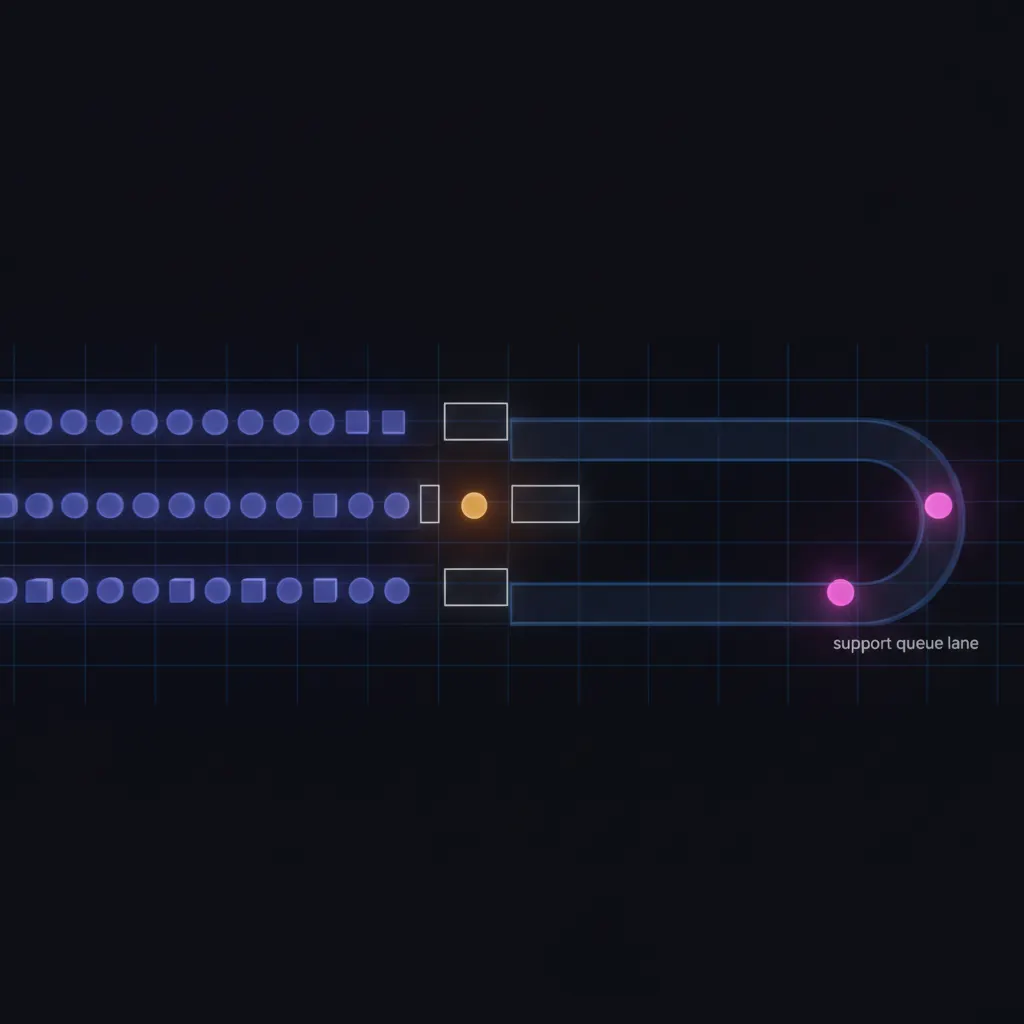
Support tickets flagged for onboarding language before they close. The agent reads every inbound ticket, classifies onboarding blockers separately from Tier 1 questions, and routes the day-20 SSO failure to the implementation engineer with the account context attached. Same shape as the lead routing function on the sales side, run on the customer side.
Past-30 accounts triaged weekly with the actual blocker. The agent reads every account past day 30, classifies the blocker into data pending, integration failed, technical contact rotation, scope creep, exec sponsor lost, or unresponsive, and assigns each one to the CSM, the implementation engineer, or the AE with a draft outbound email and a proposed next step. The 12-account list resolves into five workstreams on a Monday morning.
Buyer-side owner changes detected before the CSM hears about it. LinkedIn signals, email bounces, and calendar invite drops flag when the technical contact on the buyer side changes. The CSM gets a brief on the new contact with a suggested intro email and the current implementation state before the next weekly.
Time-to-first-value fed nightly, not quarterly. Product telemetry gets rolled up nightly against the target time-to-live window. The dashboard shows the median at 34 days, the 90th percentile at 61 days, and the three accounts that will breach the target this week. The CS ops lead opens Monday morning with the accounts that need intervention, not the accounts that already churned.
The unit economics of a stalled onboarding pipeline
A Series B company at $18M ARR signing $470K in monthly new ARR and running time-to-first-value at 47 days is losing 4 to 7 points of first-year gross retention on the accounts that never reach steady-state usage in the first 60 days. On $5.6M annual new ARR that is $220K to $390K of first-year churn traceable to onboarding drift. Layer in the expansion tax. Accounts that hit first-value in under 30 days expand at 118 percent net revenue retention in the first renewal. Accounts that hit at 47 days expand at 94 percent. On $5.6M of new ARR the delta is $1.3M of second-year revenue.
Layer in the people math. The CSMs, the implementation engineers, the AEs, and the support leads spend a combined 40 to 70 hours a month on kickoff prep, scope doc reviews, Slack threads about stalled accounts, and support ticket reroutes. That is 480 to 840 hours a year of senior staff time on work a playbook covers, against a fully loaded hour of $180 to $260. The implementation manager hire runs $140K to $210K loaded with a two to three month ramp before time-to-value moves.
A 14-day sprint to stand up the agent runs in the low to mid five figures. Ongoing cost lands closer to one contractor than a CS hire. The 12-account triage lands on the CS ops lead's desk in week one. The first stalled account clears in week two. The onboarding telemetry feeds the CSM dashboard before the sprint closes.
What changes after the sprint
Picture the same Wednesday, 3:47 PM moment, fourteen days after the sprint ships. The CS ops lead opens the implementation tracker. Past 30 reads four accounts against the twelve from a fortnight ago. Past 60 reads one. Past 90 reads zero. The Monday triage brief shows 27 outbound touches shipped this week with the specific blocker named on each. The time-to-first-value trend on the dashboard reads 33 days and falling.
By Friday the $180K enterprise that sat at day 91 has completed SSO and logged 240 admin actions. The $96K SSO failure closed inside 48 hours after the ticket routed to the right engineer. The $52K data migration confirmation went out inside two hours on the next new account. The CFO closes the board pack with gross retention holding at 89 percent, trending toward 92 by year end.
If your onboarding currently lives on a tracker the CS ops lead opens once a week and an implementation manual written when the company had six customers, the version where every kickoff gets scoped within a day and the past-30 bucket gets triaged every Monday is fourteen days away. Customer onboarding is a function. You can hire against it, you can outsource a fractional CS ops consultant for it, or you can scope a sprint and have it running this month. The work is the same. The math is not.
 2026-09-11
Your Onboarding Queue Has 22 New Logos and Implementation Started on Six
Your VP CS opens the onboarding tracker Monday, 22 new logos closed in Q3, six kickoffs on the calendar, four sitting past day 21. A queue nobody staffed.
 2026-09-10
Your Renewals Pipeline Has 47 Q4 Contracts and CS Ran QBRs on Twelve
Your VP CS opens the renewal tracker Monday, 47 Q4 contracts, 12 QBRs booked, nine yellow health scores nobody called. A queue nobody staffed.
 2026-09-01
What a Fractional AI Support Function Owns in Its First 90 Days
Series B founders keep hiring a fourth support rep and wondering why first response is still 9 hours on a Tuesday. The queue nobody staffed has a shape, and an agent stack owns it.